

Ordering the wrong part for your off-road machinery is more than just an inconvenience—it’s a costly mistake that leads to extended downtime, wasted labor, and the frustration of sending something back. When your excavator, dozer, or tractor is out of commission, every minute counts. This guide is designed to solve that problem. We will walk you through exactly how to find and use your equipment’s serial number, the single most important piece of information you need to guarantee you get the right part on the first try, every time.
Why Serial Numbers Matter in Parts Replacement?
Think of a serial number—or more formally, a Product Identification Number (PIN)—as your machine’s unique fingerprint. While the model name (like a “D6T Dozer” or “PC200 Excavator”) tells you the general type of machine you have, the serial number tells you the exact machine. This distinction is critical.
Manufacturers constantly update and refine their equipment during a production run. A machine with serial number 01234 might have a different water pump, hydraulic filter, or electronic control unit than the machine with serial number 01235, even though they look identical sitting side-by-side.
Ignoring the serial number can lead to:
- Incorrect Parts: Ordering a part that doesn’t fit or function correctly.
- Increased Downtime: Your equipment sits idle while you wait for a return and re-order.
- Wasted Money: You may be responsible for return shipping costs and a restocking fee.
- Potential for Damage: Installing an incompatible part can sometimes cause further damage to your machinery.
A serial number removes all ambiguity. It provides parts suppliers with the precise data needed to access detailed diagrams and parts lists specific to your machine’s build date and configuration, ensuring 100% compatibility.
How to Use Serial Numbers to Identify Parts?
Using your serial number to find parts is a straightforward process once you know the steps. It transforms a frustrating guessing game into a simple lookup task.
- Locate the Plate: First, you need to find the serial number plate or stamping on your equipment. The location varies by machine type and brand (more on this below).
- Document It Accurately: These numbers can be long and complex. Don’t rely on memory. Take a clear, high-resolution photo with your phone. If the plate is hard to read, write the number down double-checking each digit. An “8” can easily be mistaken for a “B,” or a “1” for an “I.”
- Provide it to Your Supplier: When you contact a parts supplier or search an online catalog, the serial number will be the first thing you need. Entering this number into a search system will filter out all incompatible parts, showing you only what fits your specific machine.
This simple process eliminates the risk of ordering based on model year or appearance alone, which are unreliable indicators for off-road equipment parts.
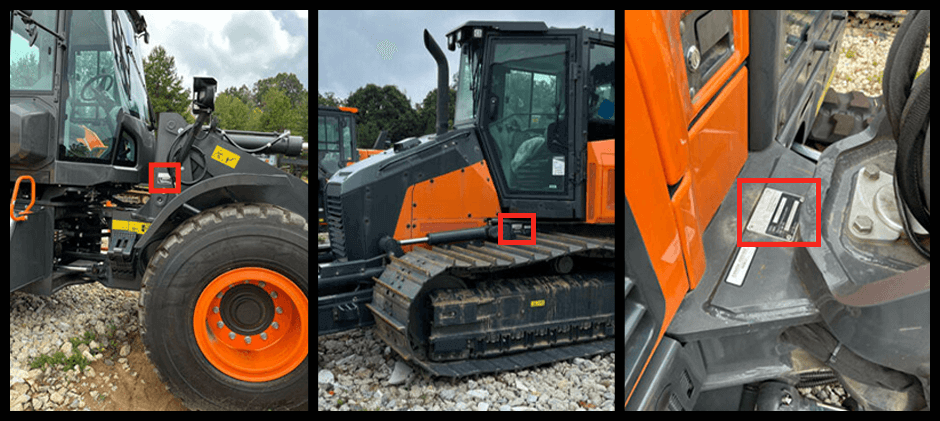
Where are Heavy Equipment’s Serial Numbers?
Finding the serial number can sometimes feel like a treasure hunt. Manufacturers place them in different locations depending on the equipment type. While it’s always best to check your owner’s manual, the table below lists the most common locations for various off-road machines.
| Equipment Type | Common Serial Number Locations |
|---|---|
| Excavator | On the main chassis frame, typically on the right side below the cab door.
Inside the operator’s cab, on a metal plate near the controls. Stamped on the base of the boom where it connects to the machine body. |
| Dozer / Bulldozer | On the rear of the machine, either on the left or right side of the main frame.
On the firewall inside the cab.<br>• On the frame rail near the front idler. |
| Skid Steer Loader | On the main frame, it is often visible when the lift arms are fully raised.
On the rear of the machine, near the engine access door.<br>• Inside the cab, on a plate attached to the side or overhead. |
| Agricultural Tractor | On the frame rail, usually on the right side near the front axle.
On the transmission or rear axle housing. Under the hood on a plate attached to the chassis. |
| Wheel Loader | On the front or rear articulation joint of the frame.
Inside the cab, often on the right-hand side panel. On the main frame near the steps to the cab. |
Always look for a small metal plate riveted to the frame or a series of numbers stamped directly into the metal.
How to Read Hard-to-See Serial Numbers?
Years of work in harsh environments can leave serial number plates covered in dirt, grease, or rust, making them nearly impossible to read. Don’t give up; here are a few field-tested techniques to reveal those hidden numbers:
1. Clean the Surface
The first step is always to clean the area. Use a wire brush to gently remove any caked-on mud or rust. A degreaser can help cut through layers of oil and grime. Be careful not to scrub so hard that you scratch the numbers off a worn plate.
2. Use the Pencil Rubbing Technique
For numbers stamped into a metal plate, this old-school trick works wonders. Place a thin piece of paper over the serial number and use the side of a pencil or crayon to gently rub across it. The impression of the numbers will be transferred to the paper, making them legible.
3. Use Angled Light
Sometimes, all you need is a different perspective. Use a bright flashlight and hold it at a sharp angle to the plate. This creates shadows in the indentations of the numbers, making them stand out visually.
4. Take a Photo and Enhance It
Use your smartphone to take the highest-resolution photo you can. Then, use your phone’s photo editor to increase the contrast and sharpness. This digital trick can often make faint numbers pop out.
Once you have your serial number, the most difficult part of the job is done. The next step is finding a reliable supplier with the inventory and expertise to get you the right component. This is where choosing a high-quality aftermarket supplier can save you significant money without sacrificing performance. Instead of paying a premium for OEM parts, you can find durable and reliable equipment parts designed to meet or exceed original specifications. Many owners also find it helpful to search for parts by brand to ensure they are looking at the correct catalog for their machine.
Conclusion
Now that you understand how to locate and use your machine’s serial number, you can confidently source the parts you need. The final step is choosing a supplier that offers quality, value, and a comprehensive selection. At FridayParts, we specialize in providing a vast inventory of high-quality aftermarket parts for a wide range of heavy equipment brands. Our products deliver the durability and reliability your work demands at an affordable price, helping you get your machinery back in operation quickly and cost-effectively.
