

If your off-road machine won’t start, surges under load, or keeps stalling on the jobsite, the fastest way to stop wasting time is to identify the exact Briggs & Stratton engine model number on the engine—not the equipment’s model. This guide shows you where to locate the engine model number, how the code is structured, and how to avoid the common mistakes that lead to wrong-fit parts and repeat breakdowns.
Why Decoding Your Engine Model Number?
On off-road machinery—compact turf equipment, utility machines, and portable generators used around property or on a worksite—engines often run in dust, heat, and vibration. That environment makes “close enough” part matching a bad idea. Decoding the Briggs & Stratton engine model number helps you lock down the exact configuration so you can order parts that match the engine you actually have today.
Here’s what decoding the engine model number does for you in real life:
- Stops wrong part orders. Filters, fuel solenoids, carburetors, recoil starters, and even simple hoses can vary by type code.
- Speeds up troubleshooting. Once the model/type is known, you can narrow problems to the right system (fuel, air, starting, charging).
- Helps you plan downtime. The code section often includes a date format that can hint at age, which matters when rubber parts, gaskets, and coils start acting up.
- Protects expensive components. A mismatched carburetor or fuel solenoid can cause lean running, hard starts, or flooding—problems that can snowball into bigger repairs.
Transitioning from “why” to “how,” the next step is locating the numbers in the first place, because on off-road equipment, they’re often dirty, faded, or hidden behind guards.
Where to Find Your Engine Model Number?
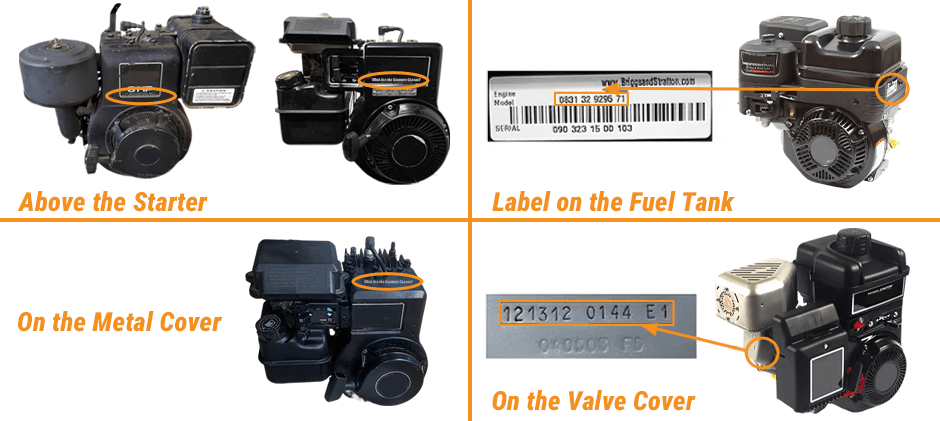
On many Briggs engines, the engine model number is stamped into metal or printed on a label/metal tag attached to the engine. Off-road use makes labels peel, and stamps fill with grime, so plan on spending 5–10 minutes just to expose the digits.
Most common locations
- Blower housing/metal shroud: Look for a flat area with numbers stamped into the metal.
- Above or near the recoil starter (pull-start engines): Sometimes a tag sits directly above the starter assembly.
- Valve cover area (common on OHV layouts): A stamped pad or label may be near the cover.
- Near the spark plug: Some engines place the stamp close to service points.
- Fuel tank label (on certain setups): A side label may carry the model/type/code.
Tools that actually help
- Flashlight or headlamp
- Phone camera (use zoom + angled light)
- Small brush + shop towel
- Mild degreaser (avoid soaking electrical connectors)
- Small mirror (for tight frames or generator housings)
Field tips for readable numbers
- Use angled light: Shine light across the stamp, not straight at it—shadows make digits pop.
- Take a photo and edit it: Increase contrast/sharpness; sometimes the number appears on-screen even when your eyes miss it.
- If the number seems “short”: Some engines show fewer digits than expected. If your system asks for a leading digit, adding a 0 in front can be required in some catalogs.
One more thing that trips people up on off-road machines: the equipment’s frame tag (the whole machine) is not the same as the engine ID. You want the stamp/tag that’s physically on the engine itself.
How to Decode the Engine Model Number?
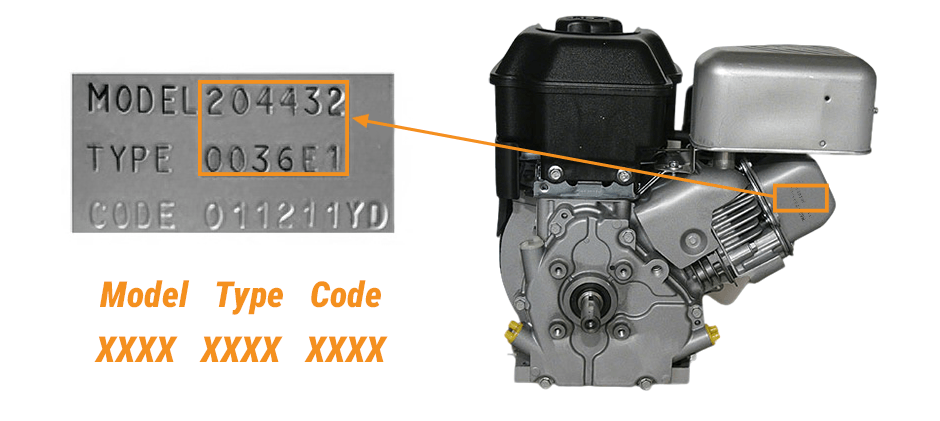
Once you’ve found the Briggs & Stratton engine model number, don’t stop at the first group of digits. For accurate parts matching on off-road machinery, capture Model + Type + Code and decode them as a set.
Decoding example: 121602-0144-E1-150818YS
Let’s break it down the same way you should when ordering parts or checking diagrams.
1) Model: 121602
- What it is: the core engine identifier (basic design and major specs).
- What you can infer: the leading digits (here, “12”) often point to a specific engine family/series used by Briggs & Stratton.
- What you should not assume: model digits alone are usually not enough to pick the correct carburetor, fuel solenoid, starter, or charging parts—off-road applications may use different variants.
2) Type: 0144-E1
- What it is: the “variant” of that model—this is where many fitment differences live.
- Why it matters: type numbers commonly change details like:
- carburetor setup and linkages
- ignition components
- crankshaft/starter/charging configuration
- About the suffix (E1): suffixes like E1 are commonly tied to emissions/compliance versions or spec packages. The practical takeaway is simple: keep it with the type when searching, because it can affect which parts list applies.
3) Code: 150818YS
- What it is: a production/build code that often starts with a date pattern.
- How to read the date portion: 15 08 18 → August 18, 2015
- What the trailing letters mean: the ending letters (here, “YS”) are typically factory/line identifiers. In many cases, they don’t change basic service part fitment, but you should still record them because some catalogs use the full code string.
Quick summary table
| Segment | Example | What does it help you do |
|---|---|---|
| Model | 121602 | Get into the correct engine family and base diagrams |
| Type | 0144-E1 | Match the exact configuration (often the difference between “fits” and “almost fits”) |
| Code | 150818YS | Confirm build date/version; useful when parts changed over time |
Practical tip
If a machine has been repaired before (common on work units), the engine model number is still your best “source of truth” for engine parts—better than guessing by horsepower, engine shape, or what the previous owner said. When you shop, search using the full string (or at least model + type), then confirm the part against the listing details.
Common Misconceptions and Troubleshooting
Even with the number in hand, a few predictable issues cause wrong orders or dead-end troubleshooting. Use the list below as a “sanity check” before you spend time and money.
Misconception 1: “The equipment model number is enough.”
It’s not. The chassis/vehicle tag identifies the machine, not the engine configuration. For engine service parts, the engine model number (plus type/code) is the reliable path.
Fix: Always pull the ID from the engine stamp/tag, not the frame.
Misconception 2: “If it’s a V-twin, the carb is the same.”
V-twins can share horsepower ranges but still use different carb linkages, solenoids, and mounting patterns.
Fix: Match the type number. If your symptom is hard start, flooding, or hunting at idle, carb and solenoid matching becomes even more critical.
Misconception 3: “My stamp is unreadable, so I’ll guess.”
On off-road gear, guessing is expensive because downtime is expensive.
Fix (fast methods):
- Clean the area and recheck with an angled light
- Use a phone photo + contrast
- Check alternate locations (starter area, shroud, valve cover)
Misconception 4: “Only the model matters for electrical parts.”
Starting and charging parts often vary by engine setup (battery start vs pull start, generator regulation, harness style).
Fix: For no-crank or click-only issues, confirm the engine ID first, then test:
- Battery voltage and terminals
- Ground path to engine block
- Starter relay/solenoid signal
- Ignition switch output (if equipped)
Misconception 5: “Diesel engine parts are all separate from this topic.”
If you run off-road machinery, it’s common to maintain both gas-engine and diesel-engine assets. The workflow is the same: identify the correct engine ID, then match parts by exact numbers.
Fix: Keep a simple maintenance record with engine IDs for every unit in your fleet. It saves time during seasonal service and emergency repairs.
Troubleshooting by symptom
| Symptom on off-road equipment | What to check first | Parts that often end up replaced |
|---|---|---|
| Hard start/stalls under load | Fuel delivery + carb setup | Fuel pump, carburetor, fuel solenoid, vacuum hose |
| Pull-start won’t engage / snaps back | Starter mechanism | Recoil/rewind starter assembly |
| Runs rough after storage | Fuel system varnish | Carburetor + gaskets, fuel tank, filter (if used) |
| Generator output unstable | Charging/regulation | Voltage regulator (application-specific) |
Conclusion
Finding the correct Briggs & Stratton engine model number is the quickest way to avoid wrong parts and repeat repairs on off-road machinery. Capture model, type, and code, confirm any leading zeros, and use that exact string when shopping. When you match the engine ID first, carb, starting, and charging parts are far more likely to fit and solve the real issue on the first try.
