

When an off-road machine starts cranking too long, losing power under load, or stalling mid-shift, the fastest way to avoid wrong-fit parts is to identify the exact fuel pump by its numbers—not by a vague description like “pump for a PC-class excavator.” In this guide, we’ll explain which numbers matter, how Komatsu-style part numbering is typically structured, and a practical, step-by-step method we can use to decode a Komatsu fuel pump number and confirm fitment before we spend money or lose uptime.
Why are the numbers so important?
Off-road machinery is full of parts that look “almost the same” but are not interchangeable. With fuel pump issues, ordering the wrong unit is especially costly because it can create new symptoms (hard starting, low pressure, rail pressure faults) that look like a deeper engine problem.
Here’s why the numbers matter in daily work:
- Production changes happen inside the same model family. A machine model can have multiple revisions, wiring changes, and updated brackets or connectors.
- Parts catalogs often have serial-number breaks. That means “Pump A fits up to S/N XXXX” and “Pump B fits from S/N XXXX onward.”
- A single wrong digit can equal a different revision. Even if the mounting holes line up, the flow direction, connector, or pressure spec may not.
Part number vs. machine serial number
- Part number = identifies the component design (what you are buying).
- Machine serial number = identifies the machine configuration (what your machine needs).
Best practice for off-road owners: when sourcing a replacement fuel pump, collect both numbers. If you only have one, you slow down and verify harder.
How are Komatsu Part Numbers Built?
Komatsu part numbers are commonly shown as 10-digit numeric codes, often displayed with hyphens for readability. The hyphens help reduce typing errors and make it easier to read the number in service notes, purchase orders, and parts lists.
What you can say confidently
In the field, you typically see Komatsu-style part numbers formatted like:
- XXXXX-XXXXX (10 digits total)
- sometimes shown with additional suffix notes in catalogs (revisions/supersessions)
Important: There isn’t a single public “decode every digit” chart that works for every Komatsu component. Different groups (engine, hydraulic, electrical, purchased components) can follow different internal rules. So our goal is a reliable ordering workflow, not a magic trick.
A practical “structure-first” view
When you look at a Komatsu part number for a fuel pump, you treat it as having three layers:
- Base number (the core identity)
- Revision or supersession (what it was replaced by / what replaces it)
- Fitment constraints (serial breaks, options, region, emissions tier)
That’s why decoding is never just “read the digits”—you also confirm the machine build range and configuration.
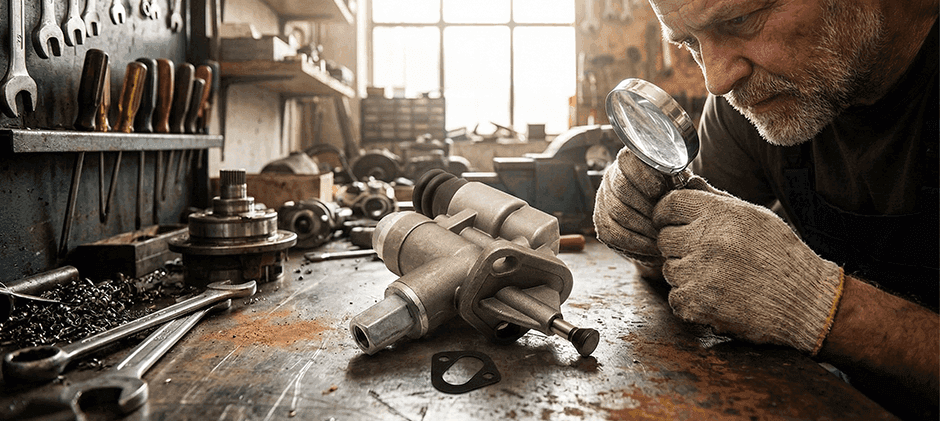
How to Decode Komatsu Fuel Pump Number?
This is the method we use to decode and verify a Komatsu fuel pump number in a way that holds up during ordering, installation, and troubleshooting.
Step 1: Identify which “number” you’re holding
Before decoding, you should make sure you’re not mixing up labels.
On an off-road machine, you may find:
- Machine serial number plate (on the frame/cab area)
- Engine model/serial plate (on the engine)
- The fuel pump label or stamping (on the pump body)
- A casting number (not always the orderable part number)
- A supplier/manufacturer code (traceability, not always the Komatsu order code)
What you want for ordering: the orderable part number from the pump tag, packaging label, or the parts catalog line item.
Quick tip: If the number is on a worn casting and not on a label/tag, we treat it as “suspect” until cross-checked in a catalog.
Step 2: Normalize the format
Real-world numbers often come in messy forms:
- with spaces, missing hyphens, or extra characters
- partially rubbed off
- misread digits (0/O, 1/I, 5/S)
Normalization checklist
- Rewrite it as XXXXX-XXXXX if it’s 10 digits.
- Circle uncertain digits and take a close-up photo.
- Compare the printed number to any barcode text if present.
Step 3: Confirm the pump type before you decode further
Komatsu off-road machines can use different fuel pump setups depending on the engine system:
- Low-pressure supply/lift pump (feeds fuel to filters/injection system)
- High-pressure pump (common rail systems; completely different risk level)
- Priming pump (manual priming components in the filter head area)
Why this matters: the same symptom (stalling) can come from restriction, air ingress, relay/voltage drop, or a failing pump.
A mid-troubleshooting reminder: intermittent no-start or “dies when hot” can be electrical, not mechanical. If you suspect power supply issues, review these relay-related warning signs before you replace a good fuel pump: Common relay failure signs that can mimic a bad pump
Step 4: Use the part number to locate supersessions
Even if your part number is correct, it might be obsolete. In Komatsu ecosystems, it’s common for a number to be replaced by a newer service part.
What you do:
- Search the exact part number in a catalog or supplier database.
- Look for notes like:
- “Replaced by …”
- “Use instead …”
- “Updated part …”
- Record both the old and new numbers.
Why you care: If you order the old number blindly, you may get delays, returns, or a “fits-but-not-right” revision.
Step 5: Pair the part number with the machine serial number
This is the step that prevents most wrong-fit fuel pump orders.
Even if two machines share a model name, Komatsu often splits fitment by:
- machine serial number range
- options (attachments, regional spec, harness version)
- engine variant and emissions tier
Our rule: Don’t treat a fuel pump number as “decoded” until you confirm it matches the machine’s build range.
Fitment verification checklist
- Machine model (example format: prefix + size + series)
- Machine serial number (exact)
- Engine model code (exact)
- Pump part number (exact)
- Connector style/voltage (photo)
- Mounting style and port orientation (photo)
Step 6: Decode what the number can tell you
A Komatsu part number usually tells us:
- The exact component identity used in parts ordering systems
- The revision trail (through supersession history)
What it usually does not tell us directly:
- flow rate or pressure spec
- whether the pump is “electric vs mechanical” (that comes from the catalog line description and the machine configuration)
So you keep decoding grounded:
- Decode = identify the correct orderable item
- Verify = confirm it fits your serial range and configuration
Step 7: Cross-check with visual and functional “sanity checks”
Before you buy, you confirm the replacement will match:
- Electrical connector (pin count, plug shape)
- Mounting bracket (bolt pattern, isolators)
- Port type (banjo vs barb; diameter)
- Flow direction (arrow orientation)
- Voltage (12V/24V systems)
This is also the right point to shop efficiently. If you’re comparing options across heavy equipment brands and applications, a dedicated fuel pump catalog makes side-by-side validation easier: fuel pump
And when you’re consolidating other wear items (filters, sensors, solenoids) into one order to reduce downtime, a brand landing page can speed up the “add everything once” workflow. Here’s the page you asked us to use for heavy equipment parts browsing: Komatsu parts
FAQs
1) Can we decode a Komatsu fuel pump number without a parts catalog?
We can often identify the family and find likely matches, but we should not finalize an order without a catalog cross-check (or supplier database) plus the machine serial number. Serial breaks and revisions are the main reason.
2) What if the part number on the fuel pump is unreadable?
We use a backup sequence:
- machine model + serial number
- engine model code
- photos of the pump (ports, connector, bracket)
- Then we match by configuration. If we guess based on “looks similar,” returns are likely.
3) Why does the same machine model have multiple fuel pump options?
Production updates, harness changes, emissions variants, and supplier changes happen over a model’s life. Komatsu often documents these as serial breaks or supersessions.
4) Does a superseded part number mean the old pump was “bad”?
Not necessarily. Supersession can be driven by supply chain changes, minor design updates, or standardization. What matters is ordering the currently valid number that fits your machine range.
5) Should we replace the fuel pump immediately when we have low pressure?
Not always. On off-road machines, low pressure is often caused by clogged filters, air leaks on the suction side, or electrical voltage drop (relay, corroded ground). It’s smart to rule those out so we don’t replace a good fuel pump.
Conclusion
When we decode a Komatsu fuel pump number the right way—normalize the part number, check supersessions, and confirm serial-break fitment—we avoid the most expensive mistake in field repairs: wrong parts and repeated tear-down. As an aftermarket parts supplier, FridayParts supports off-road owners with high-quality products at affordable prices,
