

When your Komatsu machine throws code CA559, the engine may crank longer than normal, lose power, or refuse to start—right when you need it most. This guide explains what code CA559 means, how to troubleshoot it on off-road machinery in a clean, repeatable order, and what repairs usually clear the code without swapping expensive parts first.
What is Komatsu Error code CA559?
Code CA559 is a fault related to low common rail pressure (engine controller system). In service references, it is tied to User Code E15 and described as a common rail low-pressure fault in the fuel system.
What you typically see on the machine
When code CA559 is active, common field symptoms include:
- The engine does not start or starts with difficulty.
- Black exhaust smoke (rich/poor combustion due to incorrect fuel delivery)
- Engine output drops (weak response under load)
What does the controller usually do?
Controller response is often listed as “no particular response”—meaning the machine may not go into a dramatic “limp mode,” but the engine’s behavior tells the story.
How the fault is reproduced
A typical reproduction method is simple: start the engine. If the system cannot build/hold the required pressure, code CA559 appears again.
The one data point that matters during diagnosis
Many Komatsu machines allow you to monitor rail pressure via a monitoring item, such as:
- Monitoring code: 36400 (Common rail pressure)
That live value helps you separate “electrical noise” from a real fuel supply/pressure problem.
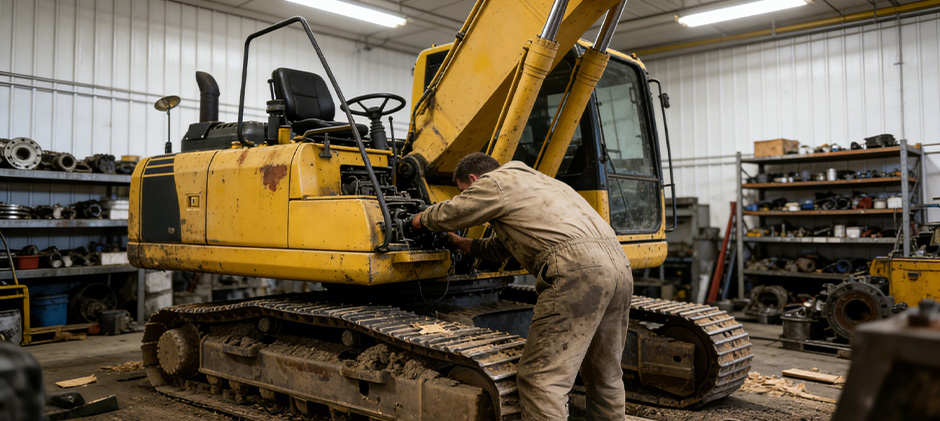
Troubleshooting Komatsu code CA559
Troubleshooting works best when you move from easy/visible checks to measured checks. Skipping straight to the injectors or the supply pump often leads to high cost and no fix.
Safety notes
- Common rail systems can involve very high pressure. Never crack open high-pressure lines with the engine running.
- Wear eye protection, keep ignition sources away from diesel, and capture fuel in a suitable container.
- If you’re not set up for pressure testing, stop at visual checks and basic maintenance, then escalate to a qualified tech.
1) Check for external fuel leakage
Possible cause: fuel leaking outside
Detection method: visual inspection while the engine is idling at low RPM (if it will idle).
Look for:
- Wet fittings at the fuel filter head, supply pump area, and return junctions
- Cracked hoses, chafing marks, loose clamps
- Diesel smell or damp dust “mud” around connections
Why it triggers the code: a small suction-side air leak or a pressure-side seep can prevent stable low-pressure feed, which then prevents the rail from building pressure.
2) Verify the low-pressure circuit with a gauge
Possible cause: partial failure of low-pressure circuit parts
A standard diagnostic path is to measure low-pressure fuel feed at a test point near the main fuel filter (service procedures often describe removing a fuel pressure inspection plug and connecting a pressure gauge).
Typical reference values from service procedures (model-dependent) are:
- Low idle: 0.50.50.5–1.31.31.3 MPa
- When starting: 0.30.30.3–1.11.11.1 MPa
If measured pressure is below spec, focus on:
- clogged filter/restriction
- air ingress on the suction side
- weak supply (feed) pump
- blocked pickup/strainer in tank
- pinched or internally collapsing hose
Practical tip: If the engine won’t start, some procedures allow measuring during cranking—just avoid long cranking cycles to protect the starter (commonly keep attempts within ~20 seconds).
3) Test the pressure limiter leak
Possible cause: defective pressure limiter
A common method is to measure fuel return from the pressure limiter over a fixed time at low idle.
Typical reference standard value:
- At low idle: 0 cc (no leak)
If the limiter leaks when it shouldn’t, rail pressure may stay low even if the low-pressure feed is okay.
4) Check the injector return (leak-off) because one bad injector can pull down the system
Possible cause: defective injector (including high-pressure piping in the head). Service methods often measure injector return volume over 1 minute.
Typical reference values:
- At low idle: 180 cc/min
- When starting: 90 cc/min
Interpretation (general approach):
- If the return volume is too high, fuel is bypassing internally, and rail pressure drops.
- If the return is abnormal on one cylinder (when tested per injector, if your procedure supports it), that injector becomes the suspect.
5) Check the supply pump return
Possible cause: defective supply pump
A reference method measures the supply pump return for 1 minute.
Typical reference values:
- At low idle: 1000 cc/min
- When starting: 140 cc/min
If the return flow is not within spec (again, model-specific), the supply pump may not be regulating or delivering correctly.
How to Solve Komatsu code CA559?
Once testing points to a direction, fixes should follow the same logic: restore a clean fuel supply, stop leaks/air, ensure water separation, and confirm pressure holds.
Fix path A: Fuel restriction/contamination
Actions that often clear code CA559 when the low-pressure feed is low:
- Replace the fuel filter (and pre-filter if equipped)
- Drain and service the water separator (water in fuel causes poor pressure stability and rough running)
- Inspect fuel tank cap venting (a blocked vent can starve the supply)
- Clean/inspect the tank pickup screen if accessible
If you need replacement maintenance parts for off-road machinery, these categories are the fastest way to match by application:
Why this works: low-pressure problems often start with restriction. If the supply pump can’t get enough clean fuel, the rail never builds stable pressure.
Fix path B: Air ingress or external leakage
If there’s wetness, fuel smell, or intermittent behavior:
- Tighten clamps and fittings to spec where applicable
- Replace cracked hoses and worn seals
- Pay attention to any line section that rubs on brackets or the frame
For replacement hose/pipe sets and related items, browsing the heavy equipment-oriented category can speed up sourcing:
Tip: Air leaks on the suction side may not drip fuel outward, but they still kill pressure. A “dry leak” is still a leak.
Conclusion
Clearing Komatsu code CA559 is about finding why the rail can’t build pressure: leakage, restriction, limiter dump, injector leak-off, or supply pump issues. Start with visible leaks and filter/separator service, then move to measured tests so parts are replaced for a reason. If you need cost-effective replacements, we at FridayParts support off-road machinery owners with a wide inventory, solid compatibility across heavy equipment brands, and high-quality aftermarket parts at affordable prices.
