

When an off-road machine gets hard to start, idles rough, misfires under load, or suddenly burns more fuel, spark plugs are one of the first parts worth checking—because they’re cheap, fast to inspect, and they tell a clear story about what’s happening in the cylinder. This guide shows how to decide when to check/replace, how to spot a bad plug, how to test it the right way, and how to clean a fouled plug without causing extra damage.
Spark Plugs vs. Glow Plugs
Many off-road machines use gasoline/LPG engines that rely on spark plugs to ignite the air‑fuel mixture inside the cylinder head. Some off-road machines use diesel engines, and diesel engines typically do not use spark plugs for ignition. Instead, many diesels use a glow plug system to preheat the chamber for easier cold starting (and sometimes afterheating to help fuel/emissions performance).
If the machine is diesel and has cold-start trouble, browsing a diesel glow plug catalog is more relevant than shopping for spark plugs.
Quick check:
- If there’s an ignition coil and plug wires/boots → likely spark plugs.
- If there’s a glow plug relay/timer/controller and a “glow” indicator → likely glow plugs.
When To Check & Replace Spark Plugs?
Off-road machinery runs in dust, vibration, wide temperature swings, and long idle cycles. That environment speeds up deposit build-up and stresses ignition parts. Checking spark plugs on a schedule reduces no-start surprises and helps catch issues early (air restriction, rich running, oil control problems, weak ignition output).
Check your spark plugs at these times
- Start of the busy season (before heavy use begins)
- After long storage (especially with old fuel or repeated failed starts)
- After hard-working weeks (frequent high-load operation or many start/stop cycles)
- Any time symptoms show up, such as:
- Hard starting or needing repeated cranks
- Uneven idle, “popping,” or random misfire
- Loss of power under load (bucket work, pushing, lifting)
- Fuel use is increasing without a workload change
- Abnormal exhaust smell/smoke (paired with plug deposits)
Replace vs. inspect: a practical rule
A plug can look “okay” but still misfire under compression. If the machine is downtime-critical, replacement is often the smarter move when there’s doubt—especially if electrodes are rounded, or the insulator is stained/cracked.
To keep decisions consistent, use this simple table:
| Situation on an off-road machine | Best action |
|---|---|
| Routine maintenance, no symptoms | Inspect + verify gap |
| Hard starting after storage | Inspect; replace if fouled/wet or worn |
| Misfire under load | Replace the plug first, then test the ignition output if needed |
| Plug repeatedly fouls | Fix the cause (air/fuel/oil), then replace |
Transition: once the timing is clear, the next job is learning what “bad” looks like—because a plug’s condition is a quick diagnostic report.
How To Tell if a Spark Plug is Bad?
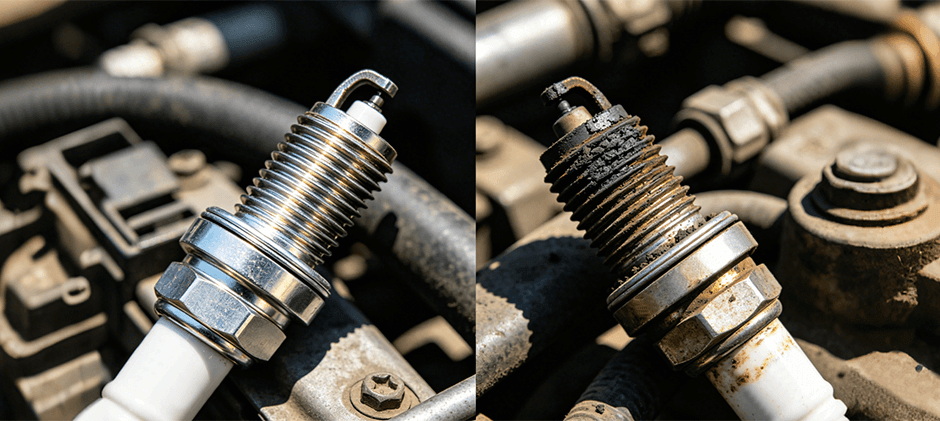
A “bad” plug can be physically damaged, electrically weak, or simply dirty enough that the spark becomes inconsistent. In off-road work, the most common causes are carbon fouling (from rich running or long idling) and wear (rounded electrodes increasing the voltage needed to spark).
Fast visual and functional signs
Look for these red flags during inspection:
- Cracked porcelain on the insulator
- Burned/rounded electrodes (edges no longer sharp)
- Heavy deposits that won’t brush off
- Fuel-wet plug after repeated no-start cranking
- Loose terminal or damaged threads
- Gap out of spec (too wide often causes weak spark under load)
Don’t miss the “wrong plug” problem
Choosing the correct plug matters. Key fit/spec items include:
- Thread size (wrong size can damage threads or fail to seal)
- Heat range (too hot/too cold changes deposit control and overheating risk)
- Electrode gap (too small or too large can cause poor combustion or a weak spark)
These are core selection factors for off-road engines, and they should match the machine’s engine specifications.
Transition: after identifying likely failure signs, the next step is a clean, repeatable check process that avoids debris in the cylinder and confirms spark strength.
How To Check Spark Plugs?
This section is the “no drama” method: safe removal, reliable inspection, gap check, and a simple spark verification.
Tools that make the job faster
- Spark plug socket (correct size) + ratchet
- Feeler gauge (for spark plug gap)
- Nylon brush or small wire brush
- Compressed air (helpful in dusty compartments)
- Inline spark tester (optional but highly useful)
- Dielectric grease (optional for boots, if approved by the machine maker)
Step-by-step procedure
- Shut down and cool the engine. Remove the key and follow the lockout steps used on the site.
- Clean the area around the plug. Dust and grit are common on loaders, tractors, and compact equipment. Blow off the area so debris doesn’t fall into the cylinder during removal.
- Remove the plug, boot/lead carefully. Pull on the boot—not the wire.
- Remove the spark plug using a proper plug socket.
- Inspect the plug (tip deposits, cracks, electrode wear, threads, and sealing washer condition).
- Measure the gap with a feeler gauge and compare it to the engine spec.
- An inline spark tester gives a clearer answer than “holding the plug to metal.”
- If the spark is weak or inconsistent, the plug may be bad—or the issue could be coil output, wiring, or a safety interlock circuit.
- Confirm spark (recommended if misfire/no-start).
- An inline spark tester gives a clearer answer than “holding the plug to metal.”
- If the spark is weak or inconsistent, the plug may be bad—or the issue could be coil output, wiring, or a safety interlock circuit.
- Reinstall correctly.
- Thread by hand first to avoid cross-threading.
- Tighten to the equipment manual’s spec. Over-tightening can strip threads; under-tightening can cause blow-by and overheating around the seat.
A short checklist for “engine cranks but won’t start.”
If the machine cranks and tries to catch but won’t run, use this order to avoid bouncing between systems:
- Confirm fresh fuel / correct fuel valve position
- Check air intake restriction
- Check the spark plugs’ condition and gap
- Verify the spark with a tester
- Then move to fuel delivery/carb settings if the spark is strong
Where buying parts fits naturally (mid-to-late in the job):
Once inspection shows the plug is worn, out of spec, or repeatedly fouled, replacement is usually faster than trying to “save” it. For heavy-equipment and off-road engine ignition needs, browse this catalog of spark plugs and related ignition components (wires, connectors, coils) so the machine can return to work with reliable starts and smoother operation.
Transition: if fouling is mild and there’s a reason to keep the plug temporarily (field fix, diagnostics), cleaning can help—if it’s done carefully.
How To Clean Fouled Spark Plugs?
Cleaning works best for light-to-moderate carbon and short-term troubleshooting. It is not a cure for a cracked insulator, burned electrodes, or a plug that’s simply worn out.
When cleaning is worth doing
- The plug is not cracked, and the threads are good
- Deposits are mostly dry soot (not heavy glaze or metal damage)
- A quick restore is needed to confirm whether the plug is the main problem
- Replacement parts aren’t immediately available on-site
Safe cleaning method
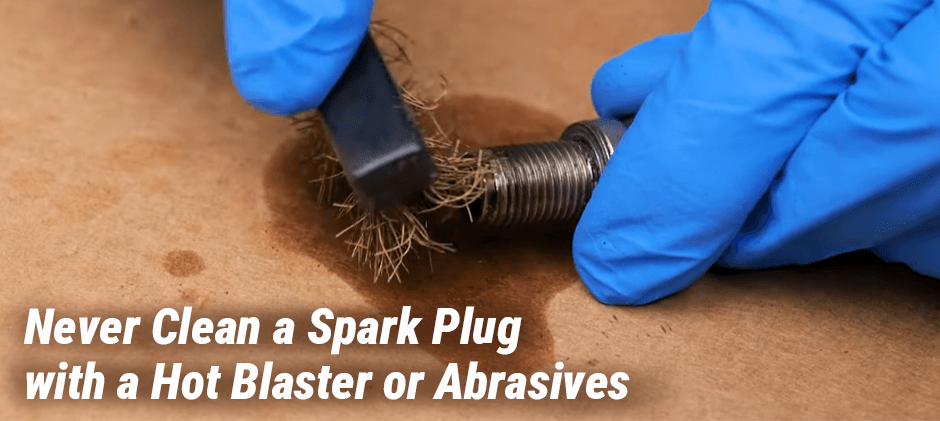
- Brush the deposits using a wire brush (or a plug-cleaning brush). Focus on the ground strap and tip area.
- Use a spray-on plug cleaner designed for plugs, if available. Wipe dry.
- Dry completely. A fuel-wet plug must be dry before reinstallation.
- Re-check the gap and reset it to spec.
- Reinstall and test under load. Let the engine warm up and apply a real working load if possible; some misfires only appear under compression and heat.
What not to do
- Do not use abrasive blasting media (shot blasting/sand). Grit can remain embedded and create cylinder wear or misfire problems.
- Don’t “file” electrodes aggressively. A plug can end up with the wrong shape and a weaker spark path.
- Don’t keep cleaning a plug that fouls repeatedly. That’s treating the symptom, not the cause.
If fouling keeps returning, fix the cause
Repeated fouling in off-road machinery usually tracks back to one of these patterns:
- Too rich: choke staying on, carb setting off, fuel delivery issues
- Too much idle time: plug never gets hot enough to burn deposits clean
- Restricted intake: clogged air filter causing rich operation
- Oil control issue: overfilled oil, steep-angle operation, breather problems, wear
A practical approach is: correct the cause → install new spark plugs → confirm stable idle and clean acceleration under load.
Diesel note
If the engine is diesel and cold starts are the issue, spark plug cleaning won’t apply. Cold-start problems often point to the glow plug circuit (plugs, relay, timer/controller). In that case, the correct parts category is glow plug.
Quick Summary Table
Conclusion
Checking and cleaning spark plugs is one of the fastest ways to restore reliable starting and smooth power in off-road machinery. Inspect safely, verify the gap, and use a spark tester when misfires or no-start issues show up. Clean only when fouling is mild, and the plug is still in good shape; replace worn plugs instead of reworking them. For diesel cold-start issues, focus on glow plug components rather than spark ignition.
