

A vibrating mower that leaves uneven grass is more than an annoyance—it can wear out spindle bearings, stress the deck, and make every job harder than it should be. This guide explains how to balance a mower blade the right way (after sharpening or when vibration shows up), what causes blades to go out of balance, and how to keep your off-road mower cutting clean with fewer repairs.
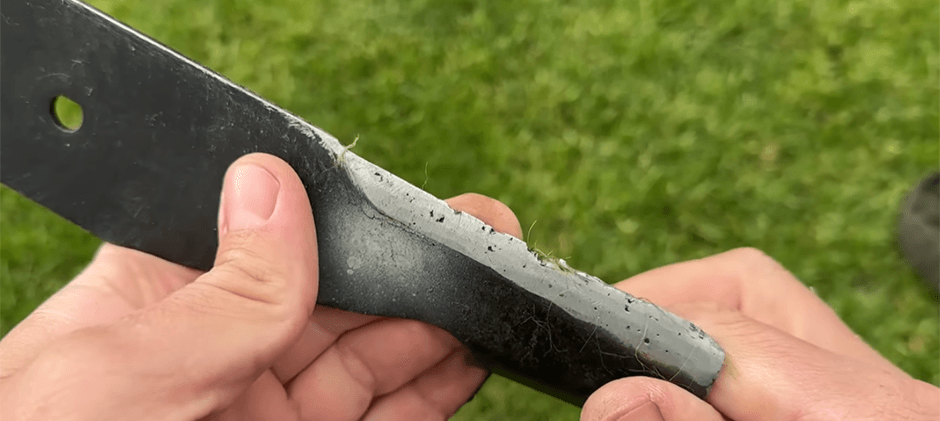
Why do Blades Become Unbalanced?
A mower blade spins fast. Small weight differences between the left and right ends can turn into big vibrations. Most imbalance problems come from a few common causes—many of them happen during normal off-road mowing, especially when the mower works near dirt edges, gravel, hidden roots, or uneven ground.
1) Uneven sharpening
If more metal is removed from one end than the other, that end becomes lighter. The heavier side will drop when balancing, and the mower may shake when running.
Typical pattern: the blade was sharpened quickly on one side, or one cutting edge had more nicks and needed more grinding.
2) Impact damage
A blade that hits a solid object can:
- bend slightly (sometimes hard to see),
- chip an edge,
- twist at the ends.
A bent blade can sometimes appear balanced in a simple test, but still cut unevenly and stress the deck. If there is a bend, replacement is often the better choice.
3) Built-up grass, dirt, and rust
Packed grass on one side adds weight. Rust can remove metal unevenly over time. Both can shift the balance.
Good habit: clean the blade fully before balancing. Balancing a dirty blade is like weighing a muddy boot—results won’t be reliable.
4) Normal wear over time
Blades slowly lose metal from sand and soil contact, and the wear may not be even across both ends. That’s why inspections matter, even when the mower “still works.”
5) Incorrect installation or hardware issues
Sometimes the blade is fine, but the problem is the mounting:
- wrong orientation (up/down),
- a damaged blade bolt/washer,
- debris on the mounting surface,
- worn spindle/shaft parts.
This can cause vibration that feels like an imbalance.
Quick “cause → sign → fix” table
| Cause | What you notice | What to check | Best fix |
|---|---|---|---|
| Uneven sharpening | New vibration after sharpening | The balance test shows that one end drops | Remove a little metal from the heavy side (edge only), re-test |
| Bent blade | Uneven cut, clunking, persistent vibration | Straightness check + visual inspection | Replace blade |
| Grass/dirt buildup | Vibration comes and goes | Heavy caked debris on one side | Clean the blade and deck, then balance |
| Rust wear | Gradual vibration over time | Thin spots, pitting, uneven wear | Replace if metal is weakened; otherwise, sharpen + balance |
| Install/hardware issue | Vibration right after reinstall | Blade orientation, bolt, mounting face | Reinstall correctly, replace worn hardware |
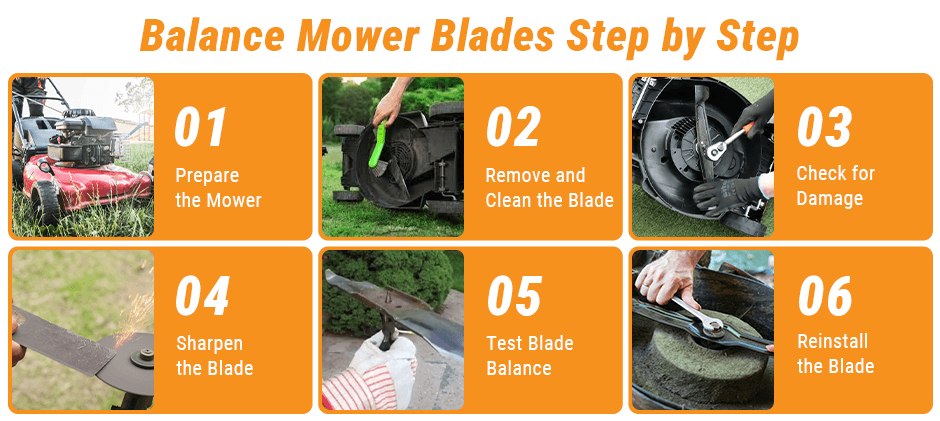
How to Balance a Mower Blade?
This section is the main workflow. It’s written for off-road mower owners who want a repeatable method that works whether the mower is a walk-behind, rider, or zero-turn (as long as it uses a standard deck blade).
Tools and supplies
- Work gloves and eye protection
- Socket/wrench set
- Blade block or clamp (to stop blade movement)
- Stiff brush or scraper (for cleaning)
- Metal file or grinder (for sharpening and small corrections)
- Blade balancer (cone-style or magnetic-style is more accurate than a nail)
- Torque wrench (recommended)
Safety note: Prevent accidental starts before touching the blade. On gas mowers, disconnect the spark plug lead; on battery units, remove the battery.
Step 1: Make the mower safe and stable
- Park on a flat surface and let the hot parts cool.
- Disable the start system (spark plug lead off / battery removed).
- Raise the deck as needed, or tilt safely based on your mower design.
- Block the blade so it cannot rotate while loosening the bolt.
Why this matters: blade work is where most DIY mistakes happen—slips, pinched fingers, and damaged threads are common when the blade isn’t secured.
Step 2: Remove and clean the blade completely
- Remove the blade bolt and washers.
- Mark the blade’s “deck side,” so it goes back the same way.
- Scrape off caked grass and dirt. Brush until the metal is visible.
Tip: If there is heavy buildup under the deck, clean it too. A clean deck reduces future buildup and helps airflow for a better cut.
Step 3: Inspect for “replace now” damage
Before balancing, confirm the blade is worth saving. Replace if you find:
- cracks (even small ones),
- severe bends or twists,
- missing chunks,
- very thin edges or heavy pitting.
Balancing a blade that should be replaced can still leave unsafe vibration and poor cutting.
Step 4: Sharpen evenly
Sharpen both cutting edges with the same angle and a similar number of passes. The goal is not razor-sharp; it’s a strong, consistent edge that cuts cleanly without chipping.
Practical target: sharp enough to cut cleanly, not so thin that it folds or chips on the first hidden stick.
Step 5: Test balance
There are three common methods. All can work, but accuracy differs.
Option A: Cone-style or magnetic balancer (recommended)
- Place the blade’s center hole on the balancer.
- Let it settle.
- If one end drops, that end is heavier.
This method is more precise than DIY hanging, and it helps prevent “almost balanced” results that still vibrate.
Option B: Nail-in-wall / peg method (basic)
- Hang the blade by the center hole.
- See whether one side drops.
This can catch major imbalances, but it’s not the best for fine-tuning.
Option C: Shop balancer (highest precision)
If the mower is used commercially or vibration has already caused repeated bearing issues, a shop-level balance check can be a good investment.
Step 6: Reinstall correctly
- Reinstall in the correct orientation (use your mark).
- Ensure the mounting face is clean—no trapped grass or grit.
- Tighten to the manufacturer’s torque spec.
After install: run the mower briefly and listen/feel:
- Vibration should be noticeably lower.
- The cut should look more even across the deck path.
If vibration remains, stop and re-check:
- blade balance,
- blade bolt/washer condition,
- spindle play or deck issues.
Balancing blades is a good time to look over other high-wear items that affect cut quality and reliability. If replacement is needed, it’s often cheaper and faster to order parts together from a single catalog of mower parts rather than fixing one problem at a time.
How to Maintain a Mower Blade?
Balancing is important, but it works best as part of a simple routine. The goal is fewer surprises during the busy season and a mower that cuts clean without shaking.
1) Follow a real inspection schedule
A practical schedule for off-road mowing:
- Check blade condition about every 20 hours of use for dullness, bends, chips, and heavy buildup.
- Replace blades when they are dull, damaged, or no longer sharpen well. Many owners replace blades about every 1–2 years, depending on conditions and hours.
If mowing includes sandy soil, rough patches, or debris-prone areas, expect faster wear.
2) Keep the blade clean
Clumps of wet grass can throw off balance and reduce airflow under the deck, which hurts cut quality. Clean after heavy jobs and at the end of the season.
3) Sharpen before the blade gets “destroyed.”
Sharpening a moderately dull blade is easier and removes less metal. Waiting until the edge is full of deep nicks often forces heavy grinding that increases imbalance risk.
4) Watch for belt-related cut issues
A balanced blade can still cut poorly if the deck drive system slips. If the mower struggles in thicker grass, the deck speed may be dropping.
Signs of belt problems:
- burnt rubber smell,
- shiny/glazed belt surface,
- cracking or fraying,
- uneven blade speed.
Replacing a worn belt with a compatible lawn mower belt can restore blade speed and improve cut results—especially on off-road properties where mowing load changes constantly.
5) Don’t ignore engine tune basics
If the engine runs rough, the blade speed can surge or drop, which makes cut quality worse and can feel like blade trouble.
If hard starting or rough idle shows up, checking and replacing a compatible lawn mower spark plug is one of the quickest fixes.
Conclusion
Balancing a mower blade is a quick step that protects the mower deck, improves cut quality, and makes mowing more comfortable—especially on off-road properties where impacts and debris are common. When a blade is bent, cracked, or too worn, replacement is the smarter call. As an aftermarket parts supplier, FridayParts offers high-quality products at affordable prices, a vast inventory, and wide compatibility across many heavy equipment brands—helping keep your mower running strong with less downtime.
