

The mini excavator weigh (often called the operating weight) matters for transport, performance, and job site use. Some micro models weigh just over 2,000 lbs (about 1 ton), while the largest mini excavators can be over 20,000 lbs (10 tons). Many owners want to know if they can tow the machine themselves without a CDL, or whether the job site has weight restrictions. Let’s take a look.
How Much Does a Mini Excavator Weigh?
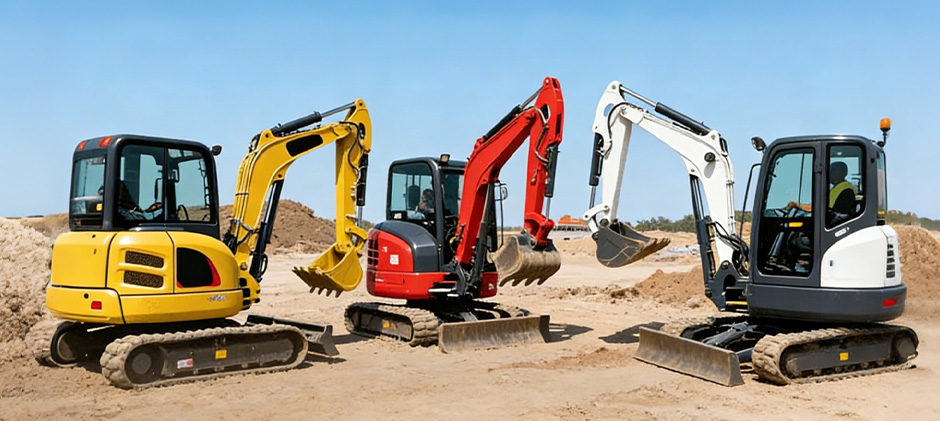
We can group mini excavators into three basic types. Exact weight varies by brand and model, so always check the manufacturer’s specs for accurate numbers.
Micro Excavators (under 4,000 lbs / 2 tons)
This is the smallest category and is mainly used in places with very tight spaces. Such as residential yard construction, interior demolition, or installing utility lines in a narrow backyard. Because it is relatively light, it can generally be transported on ordinary trailers, and the damage to lawns, paving bricks and other surfaces is relatively small.
Standard Mini Excavator (4,000–12,000 lbs / 2–6 tons)
This is the most common category, with a balanced range of power and flexibility. They are used for many construction tasks, such as digging small foundations, leveling the ground, and ordinary construction site operations. Although a bit heavier, depending on the configuration of the truck and trailer, many machines can still be towed without a CDL.
Large mini excavator (12,000 lbs / 6 tons or more)
This category is close to large excavators, with stronger excavation force and operating range, making it suitable for larger excavation projects or commercial projects. However, you need to pay more attention when transporting, generally using heavy trailers and stronger towing vehicles.
You might be curious: Why would two excavators that look similar weigh differently? Next, let’s look at what factors affect the operating Weight of an excavator.
Factors Affecting Mini Excavator Weight
A machine’s weight is determined by a mix of design, materials, and extra components.
Model and Brand
Each manufacturer designs a little differently. Some focus on lighter machines that are easier to transport, while others think heavier machines have durability and strength. Because of these different design focuses, the same size class excavators from different brands still differ by several hundred pounds.
Size
Larger machines need a bigger frame, a stronger engine, a more powerful hydraulic system, and a heavier counterweight than others. All of these parts add weight, so machine size is the biggest factor affecting total weight.
Attachments
The base weight is just the starting point. Operating weight also includes the attachment you’re using, and these can add a lot of weight. Always consider attachment weight when planning transport or checking stability.
- Buckets: The most common attachment. A standard digging bucket weighs 50–200 pounds.
- Hydraulic hammers/breakers: Used for demolition. These add 150–1,000 pounds.
- Augers: For drilling holes. An auger with drive and bit adds 200–500 pounds.
- Grapples: For moving logs or debris. These usually weigh 100–400 pounds.
Materials and Fluids
Manufacturers balance strength and weight when choosing materials. Most of the machine uses high‑strength steel for durability, while lighter parts like the cab or covers may use aluminum or tough plastics. Don’t forget fluids either. A full diesel tank and hydraulic oil can add several hundred pounds to the total weight.
Other Considerations Related to Weight
Knowing the excavator’s weight is about more than just a number; it has direct consequences on how the machine performs and how you can manage it.
Ground Pressure
Ground pressure is the pressure the excavator exerts on the ground. Simply put, it’s calculated by dividing the machine’s total weight by the area where the tracks touch the ground. Heavier machines generally have higher ground pressure. However, track design also plays a big role, such as track width and contact area.
Why is ground pressure important? On soft ground, lawns, or new asphalt, high ground pressure can leave ruts and damage the surface. Lighter machines or wider tracks work better here. They spread weight more evenly and are gentler on the ground. That’s why low ground pressure is so important for landscaping and utility contractors.
Mini Excavator’s Stability
Weight and balance are key to keeping an excavator stable. The machine has a set center of gravity, balanced by a counterweight. When you dig or lift heavy loads — especially at full reach or to the side — you’re testing how stable it is.
“An excavator’s stability is a non-negotiable safety factor. Always operate within the manufacturer’s rated lift capacity and use attachments that are properly matched to the machine’s weight class. Pushing these limits is the fastest way to create a dangerous tipping hazard.”
Using an attachment that’s too heavy can shift the center of gravity and raise the risk of tipping. This is even more important for zero-tail-swing and reduced-tail-swing models, since they depend on careful balance to stay safe.
Transport Requirements
It is very important to transport a mini excavator safely and legally. The excavator weight directly decides what kind of transport setup you should use.
- Trailer Requirements: The gross vehicle weight rating (GVWR) of a trailer must be high enough to carry the combined weight of the trailer and the excavator, and the attachment weight. For small excavators weighing around 3,000 pounds, you should have a light general-purpose trailer. However, for weighing 10,000 pounds, you need a heavy-duty equipment trailer and the corresponding braking system.
- Towing Capacity: Your truck must be rated to safely pull the total weight of the trailer and equipment. Overloading is not just illegal—it’s very dangerous. It will seriously hurt your steering and braking.
- Permit Rules: In many areas, you may need a CDL if the total weight of your truck, trailer, and excavator goes over 26,001 pounds. Different rules will apply. Always check your local and state laws first.
Final Thoughts
The excavator weight can affect many aspects of the project, especially in construction environments with complex terrain, narrow spaces, or weight restrictions. Knowing the actual weight of the equipment in advance can avoid a lot of trouble and even reduce potential safety risks. If you need it, go to FridayParts and browse the commonly used mini excavator spare parts to keep your equipment working.
Mini Excavator Weight and Specs Reference
To give you a concrete idea of the weights across different brands, we’ve compiled data from some of the most popular manufacturers in the off-road equipment industry. Note that “Operating Weight” typically includes a standard bucket, a full fuel tank, and an operator.
(Include: Bobcat, Kubota, Caterpillar, Takeuchi, Yanmar, John Deere, Komatsu, Volvo)
Bobcat
Bobcat mini excavators weigh between 2,593 pounds and 19,600 pounds. The lightest model is the Bobcat E10 and the heaviest is the Bobcat E88.
| Model | Operating Weight (lbs) | Max Dig Depth | Max Dump Height | Engine Power (hp) | Width | Tailswing |
|---|---|---|---|---|---|---|
| Bobcat E10 | 2,593 | 6′ 0″ | 6′ 0″ | 10.2 | 28″ | Zero |
| Bobcat E20 | 4,306 | 8′ 5″ | 8′ 10″ | 13.9 | 54″ | Zero |
| Bobcat E26 | 6,489 | 9′ 6″ | 10′ 10″ | 24.8 | 61″ | Minimal |
| Bobcat E35 (25 hp) | 8,590 | 12′ 10″ | 12′ 11″ | 24.8 | 69.7″ | Zero |
| Bobcat E40 | 9,180 | 10′ 10″ | 12′ 3″ | 40 | 72.8″ | Minimal |
| Bobcat E50 | 11,894 | 12′ 8″ | 13′ 11″ | 49.7 | 77.2″ | Minimal |
| Bobcat E60 | 12,646 | 14′ 10″ | 15′ 2″ | 55 | 77.2″ | Conventional |
| Bobcat E88 | 19,600 | 15′ 2″ | 16′ 6″ | 65 | 86.6″ | Conventional |
Kubota
Kubota mini excavators weigh between 2,200 pounds and 18,760 pounds. The lightest model is the Kubota K008-5 and the heaviest is the Kubota KX080-5.
| Model | Operating Weight (lbs) | Max Dig Depth | Max Dump Height | Engine Power (hp) | Width | Tailswing |
|---|---|---|---|---|---|---|
| Kubota K008-5 | 2,200 | 5′ 8″ | 6′ 8″ | 10.3 | 34″ | Reduced |
| Kubota U17 | 3,869 | 7′ 7″ | 8′ 0″ | 16.1 | 49″ | Zero |
| Kubota U27-4 | 6,173 | 9′ 5″ | 10′ 0″ | 20.9 | 59″ | Zero |
| Kubota KX033-4 | 7,533 | 10′ 6″ | 11′ 7″ | 24.8 | 61″ | Conventional |
| Kubota KX040-4 | 9,392 | 11′ 3″ | 12′ 10″ | 40.4 | 67″ | Conventional |
| Kubota U55-5 | 12,247 | 11′ 11″ | 13′ 1″ | 47.6 | 77″ | Reduced |
| Kubota KX080-5 | 18,760 | 15′ 1″ | 17′ 3″ | 66.6 | 87″ | Reduced |
Caterpillar
CAT mini excavators weigh between 2,399 pounds and 22,451 pounds. The lightest model is the CAT 300.9D and the heaviest is the CAT 310.
| Model | Operating Weight (lbs) | Max Dig Depth | Max Dump Height | Engine Power (hp) | Width | Tailswing |
|---|---|---|---|---|---|---|
| CAT 300.9D | 2,399 | 5′ 8″ | 6′ 6″ | 13 | 29″ | Conventional |
| CAT 301.7 CR | 4,222 | 7′ 9″ | 8′ 3″ | 21 | 39″ | Reduced |
| CAT 303 CR | 7,817 | 8′ 8″ | 10′ 5″ | 23.6 | 61″ | Reduced |
| CAT 305 CR | 12,688 | 11′ 3″ | 12′ 2″ | 45 | 78″ | Reduced |
| CAT 306 CR | 15,766 | 12′ 2″ | 14′ 2″ | 55.9 | 78″ | Reduced |
| CAT 308 CR | 20,077 | 15′ 2″ | 15′ 7″ | 69.5 | 90.6″ | Reduced |
| CAT 310 | 22,451 | 17′ 1″ | 19′ 2″ | 69.5 | 97.2″ | Conventional |
Takeuchi
Takeuchi mini excavators weigh between 2,535 pounds and 18,810 pounds. The lightest model is the Takeuchi TB210R and the heaviest is the Takeuchi TB280FR.
| Model | Operating Weight (lbs) | Max Dig Depth | Max Dump Height | Engine Power (hp) | Width | Tailswing |
|---|---|---|---|---|---|---|
| Takeuchi TB210R | 2,535 | 5′ 9″ | 7′ 0″ | 11.7 | 29.5″ | Reduced |
| Takeuchi TB216 | 3,900 | 7′ 10″ | 8′ 11″ | 15 | 38.6″ | Conventional |
| Takeuchi TB230 | 6,360 | 9′ 4″ | 10′ 7″ | 24.4 | 57″ | Conventional |
| Takeuchi TB240 | 8,570 | 11′ 4″ | 12′ 7″ | 35.8 | 68″ | Conventional |
| Takeuchi TB260 | 12,125 | 12′ 9″ | 13′ 10″ | 47.6 | 79″ | Conventional |
| Takeuchi TB370 | 14,850 | 13′ 5″ | 14′ 11″ | 56.9 | 83″ | Conventional |
| Takeuchi TB290 | 18,630 | 15′ 0″ | 17′ 3″ | 69.2 | 87″ |
Conventional |
Yanmar
Yanmar mini excavators weigh between 2,438 pounds and 21,671 pounds. The lightest model is the Yanmar SV08-1D and the heaviest model is the Yanmar SV100-7.
| Model | Operating Weight (lbs) | Max Dig Depth | Max Dump Height | Engine Power (hp) | Width | Tailswing |
|---|---|---|---|---|---|---|
| Yanmar SV08-1D | 2,438 | 5′ 4″ | 6′ 9″ | 10.3 | 27″ | Reduced |
| Yanmar ViO17-1E | 4,023 | 7′ 7″ | 8′ 6″ | 14.5 | 37″ | Zero |
| Yanmar ViO25-6B | 5,908 | 10′ 0″ | 9′ 2″ | 20.4 | 59″ | Zero |
| Yanmar ViO35-6A | 8,214 | 11′ 3″ | 11′ 2″ | 24.4 | 68″ | Zero |
| Yanmar ViO55-6A | 12,247 | 13′ 6″ | 13′ 3″ | 47.6 | 68″ | Zero |
| Yanmar ViO80-7 | 18,409 | 14′ 3″ | 15′ 2″ | 67 | 77″ | Conventional |
| Yanmar SV100-7 | 21,671 | 14′ 11″ | 16′ 8″ | 72 | 91″ | Reduced |
John Deere
John Deere mini excavators weigh between 3,790 pounds and 13,620 pounds. The lightest model is the John Deere 17 P-Tier and the heaviest is the John Deere 60 P-Tier.
| Model | Operating Weight (lbs) | Max Dig Depth | Max Dump Height | Engine Power (hp) | Width | Tailswing |
|---|---|---|---|---|---|---|
| John Deere 17 P-Tier | 3,790 | 7′ 2″ | 8′ 3″ | 14.5 | 39″ | Reduced |
| John Deere 26 P-Tier | 6,110 | 8′ 6″ | 10′ 6″ | 20 | 59″ | Reduced |
| John Deere 35 P-Tier | 8,135 | 10′ 0″ | 11′ 9″ | 23.3 | 69″ | Zero |
| John Deere 50 P-Tier | 10,847 | 11′ 7″ | 14′ 2″ | 35.9 | 79″ | Zero |
| John Deere 60 P-Tier | 13,620 | 12′ 4″ | 14′ 6″ | 53 | 79″ | Reduced |
Komatsu
Komatsu mini excavators weigh between 7,143 pounds and 19,224 pounds. The lightest model is the Komatsu PC30MR-5 and the heaviest is the Komatsu PC88MR-11.
| Model | Operating Weight (lbs) | Max Dig Depth | Max Dump Height | Engine Power (hp) | Width | Tailswing |
|---|---|---|---|---|---|---|
| Komatsu PC30MR-5 | 7,143 | 9′ 1″ | 10′ 7″ | 24.4 | 61″ | Reduced |
| Komatsu PC35MR-5 | 8,532 | 11′ 4″ | 11′ 9″ | 24.4 | 69″ | Reduced |
| Komatsu PC45MR-5 | 11,001 | 12′ 0″ | 12′ 2″ | 38 | 79″ | Reduced |
| Komatsu PC55MR-5 | 11,618 | 12′ 6″ | 12′ 9″ | 38 | 79″ | Reduced |
| Komatsu PC88MR-11 | 19,224 | 15′ 0″ | 15′ 8″ | 68 | 91″ | Reduced |
Volvo
Volvo mini excavators weigh between 3,748 pounds and 20,944 pounds. The lightest model is the Volvo ECR18E and the heaviest model is the Volvo ECR88D.
| Model | Operating Weight (lbs) | Max Dig Depth | Max Dump Height | Engine Power (hp) | Width | Tailswing |
|---|---|---|---|---|---|---|
| Volvo ECR18E | 3,748 | 8′ 4″ | 8′ 0″ | 16.1 | 39″ | Reduced |
| Volvo ECR25D | 5,737 | 8′ 9″ | 9′ 2″ | 20.9 | 61″ | Conventional |
| Volvo EC35D | 7,782 | 11′ 1″ | 11′ 0″ | 24.8 | 70″ | Conventional |
| Volvo ECR50 | 11,133 | 12′ 2″ | 12′ 5″ | 41.8 | 79″ | Zero |
| Volvo EC60E | 15,440 | 12′ 1″ | 13′ 7″ | 59 | 76″ | Conventional |
| Volvo ECR88D | 20,944 | 13′ 7″ | 16′ 3″ | 55 | 96″ | Reduced |
