

When a warning light appears on the dashboard of a Freightliner vocational truck or a piece of heavy equipment powered by a Detroit Diesel engine, it is rarely just a minor inconvenience; it is a threat to the day’s production and overall profitability. Navigating the complexity of diagnostic codes can be a frustrating hurdle for operators and fleet managers alike. This guide serves as a direct roadmap for identifying and resolving the top 50 Freightliner DTCs to maximize equipment uptime. By following these technical protocols, we can help you transition from a state of mechanical failure back to full operational capacity with minimal delay.
What Are Freightliner DTC Codes?
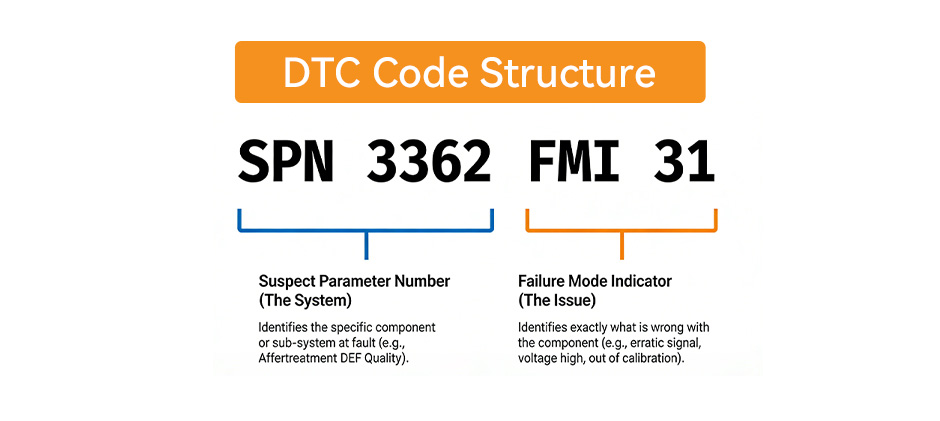
Diagnostic Trouble Codes (DTCs) are digital signals generated by the machine’s electronic control units (ECUs) when a specific parameter falls outside of the programmed operating range. In heavy-duty applications, these codes utilize a two-part structure: the Suspect Parameter Number (SPN) and the Failure Mode Identifier (FMI). The SPN points to the physical component or system that is struggling, such as a fuel pressure sensor or a turbocharger actuator. The FMI provides the specific nature of the fault, indicating whether the signal is shorted, open, or delivering data that is physically impossible. This logic allows a technician to pinpoint the source of a malfunction without relying on guesswork. By focusing on these standardized alerts, we can streamline the repair process and ensure that the correct components are serviced the first time.
The Top 10 Critical Freightliner DTCs
The following codes represent high-priority faults that can lead to immediate engine protection measures or hazardous operating conditions. Distinguishing critical vs. non-critical codes is a vital skill for field triage.
Code |
Description |
Common Fix |
Severity |
Downtime |
|---|---|---|---|---|
| SPN 3362 FMI 31 | After treatment 1 DEF Quality | Drain DEF tank, refill with fresh DEF, and clear codes. Check for SCR issues | Critical | 2-4 hrs |
| SPN 625 FMI 9 | CAN Communication Error | Check J1939 backbone, inspect terminating resistors. See CAN bus guide | Critical | 1-3 hrs |
| SPN 4364 FMI 18 | SCR NOx Conversion Low | Replace NOx sensors, update ECM calibration, check DEF doser | Critical | 3-5 hrs |
| SPN 3251 FMI 0 | DPF Soot Load High | Force regeneration, check for intake/boost leaks, and verify DPF pressure sensor | High | 1-2 hrs |
| SPN 110 FMI 16 | Engine Coolant Temperature High | Check coolant level, inspect thermostat, test cooling fan operation | Critical | 2-4 hrs |
| SPN 1569 FMI 31 | Engine Protection Torque Derate | Address the underlying fault causing the derate. Check the derate conditions | Critical | Varies |
| SPN 102 FMI 18 | Intake Manifold Pressure Low | Check turbocharger operation, inspect charge air cooler for leaks | High | 2-3 hrs |
| SPN 157 FMI 18 | Fuel Rail Pressure Low | Replace fuel filter, check fuel pump, inspect for air in fuel system | Critical | 1-3 hrs |
| SPN 3226 FMI 13 | NOx Sensor Out of Calibration | Replace the NOx sensor and perform the SCR efficiency test. Reference sensor guide | High | 1-2 hrs |
| SPN 639 FMI 13 | J1939 Network #1 Communication Error | Inspect data link connectors, check ECM connections, and verify network resistance | Critical | 2-4 hrs |
Acquiring reliable truck parts is the first step in resolving these high-priority issues. Using high-quality replacement components ensures that the root cause is permanently addressed, preventing the cycle of recurring faults that often plagues aging equipment.
Common Engine DTCs (Codes 11-20)
Detroit Diesel engines are the backbone of many heavy-duty Freightliner configurations. Technicians in off-road settings must be proficient in addressing these common air and fuel system malfunctions.
Fuel System Faults
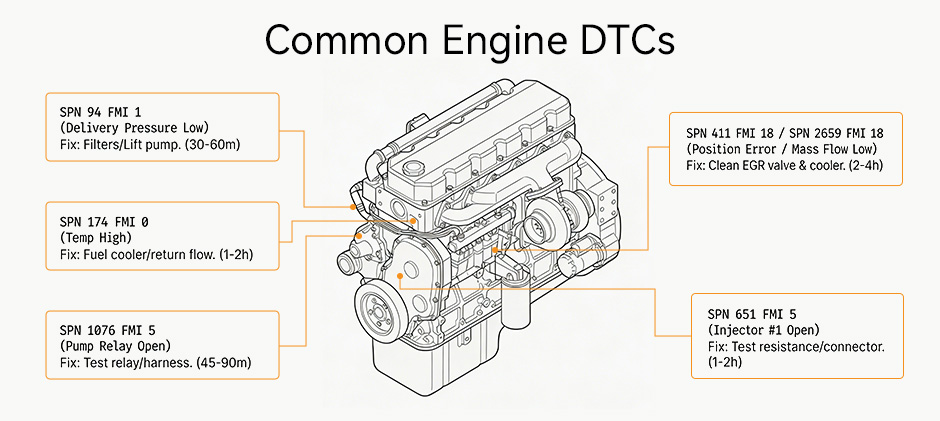
- SPN 94 FMI 1 – Fuel Delivery Pressure Low. Fix: Replace fuel filters, check lift pump operation. Ensure the primary and secondary filters are not clogged with sediment common in remote refueling sites.
- SPN 174 FMI 0– Fuel Temperature High. Fix: Check fuel cooler, verify fuel return flow. Obstructed airflow through the fuel cooler can lead to thermal expansion issues within the injectors.
- SPN 1076 FMI 5 – Fuel Pump Relay Circuit Open. Fix: Test relay, check wiring harness. On-site debris often strikes exposed harnesses; verify no branches or rocks have snagged the lines, causing an open circuit.
- SPN 411 FMI 18 – EGR Valve Position Error. Fix: Clean the EGR valve, check actuator operation. Carbon buildup is frequent in engines that idle extensively; cleaning the valve can often restore the full range of motion.
- SPN 651 FMI 5 – Injector Cylinder #1 Open Circuit. Fix: Test injector resistance, check the connector. Vibrations on job sites can loosen the internal harness connectors; ensure the locking tabs are secure.
Air & Boost System Faults
- SPN 102 FMI 3 – Boost Pressure Sensor High. Fix: Replace the MAP sensor, check for shorts. A failed sensor can trick the ECM into over-fueling, which increases exhaust gas temperatures.
- SPN 106 FMI 0 – Intake Air Pressure High. Fix: Check turbo wastegate, inspect CAC. Ensure the wastegate arm is moving freely and not seized due to external corrosion.
- SPN 1127 FMI 18 – Turbocharger Speed Low. Fix: Inspect the VGT actuator, check for exhaust restrictions. This often indicates a leak in the charge air cooler pipes or a failing Variable Geometry Turbo actuator.
- SPN 105 FMI 16 – Intake Manifold Temperature High. Fix: Check charge air cooler efficiency. Dust and mud accumulation on the cooler fins can prevent heat exchange; pressure wash the core carefully.
- SPN 2659 FMI 18 – EGR Mass Flow Rate Low. Fix: Clean the EGR cooler, check the differential pressure. If the cooler is restricted, the engine cannot properly recirculate gases, leading to performance drops.
Transmission DTCs (Codes 21-30)
Vocational Freightliner units often employ the DT12 automated transmission. These codes focus on the electronics that manage shifting and clutch engagement.
| Code | System | Description | Quick Fix | Est. Time |
|---|---|---|---|---|
| SPN 523 FMI 7 | Clutch | Clutch Actuator Not Responding | Check clutch actuator air supply, inspect solenoids | 1-2 hrs |
| SPN 524 FMI 2 | Gear Select | Gear Selector Position Erratic | Calibrate the shift actuator, check the position sensor | 45-90 min |
| SPN 560 FMI 14 | Software | Transmission Calibration Required | Perform the adaptation learn procedure with DiagnosticLink | 30-45 min |
| SPN 584 FMI 9 | Communication | TCU Communication Lost | Check TCU power and ground, inspect CAN connections | 1-3 hrs |
| SPN 177 FMI 3 | Oil System | Transmission Oil Temperature High | Check oil level, inspect cooler operation | 1-2 hrs |
| SPN 3359 FMI 2 | Input Shaft | Input Speed Sensor Intermittent | Clean the speed sensor, check the air gap | 30-60 min |
| SPN 3360 FMI 2 | Output Shaft | Output Speed Sensor Erratic | Replace the speed sensor, and verify the tone ring condition | 45-75 min |
| SPN 591 FMI 19 | Network | Transmission CAN Bus Error | Check the J1939 connection at the TCU | 1-2 hrs |
| SPN 2003 FMI 31 | Clutch Life | Clutch Wear Limit Reached | Schedule clutch replacement | 6-8 hrs |
| SPN 5018 FMI 14 | PTO | PTO Engagement Fault | Check PTO solenoid, verify interlock switches | 1-2 hrs |
Utilizing high-quality Freightliner parts from aftermarket suppliers provides a cost-effective way to handle these repairs without sacrificing reliability. Proper component selection is particularly crucial for transmission sensors, where signal precision is required for smooth gear transitions.
Electrical & Body Controller Codes (31-40)
Electrical failures are frequently caused by corrosion and harness fatigue. These codes help isolate issues within the chassis and cabin systems.
Battery & Charging
- SPN 168 FMI 0 – Battery Voltage High. Fix: Inspect the alternator voltage regulator. An overcharging condition can damage expensive ECUs and shorten battery life.
- SPN 168 FMI 1 – Battery Voltage Low. Fix: Test alternator output and check for loose or worn belts. In dusty off-road environments, also inspect battery terminals for corrosion or buildup that prevents a solid connection.
- SPN 627 FMI 12 – Alternator Not Charging. Fix: Verify the exciter wire is intact. If the alternator is not producing current under load, replace the unit.
Lighting Systems
- SPN 3039 FMI 11 – Left Headlamp Circuit. Fix: Inspect the bulb and the socket for heat damage. Test the related relay for proper switching.
- SPN 3040 FMI 11 – Right Headlamp Circuit. Fix: Check the wiring harness for abrasions. Verify the ground point on the chassis is clean and tight.
- SPN 987 FMI 5 – Turn Signal Circuit Open. Fix: Check for a blown flasher relay or a disconnected harness behind the headlight assembly.
HVAC & Comfort
- SPN 4421 FMI 5 – AC Compressor Circuit. Fix: Measure the resistance of the compressor clutch coil. If it shows an open circuit, the clutch assembly must be replaced.
- SPN 3510 FMI 31 – Blower Motor Fault. Fix: Inspect the blower motor for physical obstructions. Test the resistor block if the fan only operates on high speed.
- SPN 1636 FMI 2 – Cabin Temp Sensor Error. Fix: Clean the sensor of dust and debris. If the error persists, replace the sensor to restore climate control functionality.
ABS & Safety System Codes (41-50)
Safety systems are paramount on active job sites. These faults often limit vehicle speed or disable critical braking aids.
SPN 1043 FMI 14
Fix: Diagnose the ABS ECU and inspect all wheel speed sensor leads for damage.
Safety Status: Stop vehicle immediately. A complete ABS malfunction has been detected.
SPN 1242 FMI 13
Fix: Perform a steering angle sensor calibration using appropriate diagnostic software.
Safety Status: Stability control disabled. The system cannot accurately track steering input.
SPN 789 FMI 2
Fix: Clean the sensor face and check the tone ring for missing or damaged teeth.
Safety Status: ABS function impaired due to an erratic signal from the Right Front wheel sensor.
SPN 792 FMI 5
Fix: Check the connector for moisture intrusion and test sensor resistance levels.
Safety Status: ABS disabled on the affected wheel due to an open circuit in the Left Rear sensor.
SPN 1070 FMI 31
Fix: Check the air dryer and inspect all brake lines for audible leaks.
Safety Status: Stop vehicle immediately. The system has detected insufficient brake system pressure.
SPN 520192 FMI 31
Fix: Wipe the radar sensor face clean and check for any physical misalignment of the mounting bracket.
Safety Status: Safety features are limited. The collision mitigation radar is obstructed.
SPN 1624 FMI 9
Fix: Inspect the sensor mounting bolts and verify the CAN bus wiring integrity at the sensor.
Safety Status: Stability control unavailable due to a yaw sensor communication fault.
SPN 597 FMI 2
Fix: Readjust the brake switch clearance or replace the switch if internal contacts are failing.
Safety Status: Cruise control disabled because the brake pedal position signal is inconsistent.
SPN 563 FMI 14
Fix: Execute a full ABS diagnostic routine to identify multiple overlapping faults.
Safety Status: Schedule immediate service. The ABS warning lamp indicates a high-priority failure.
SPN 1081 FMI 2
Fix: Check the 7-way trailer cable for broken wires and verify power at the trailer connector.
Safety Status: Trailer ABS inactive. Communication has been lost with the trailer module.
DTC Response Priority Guide
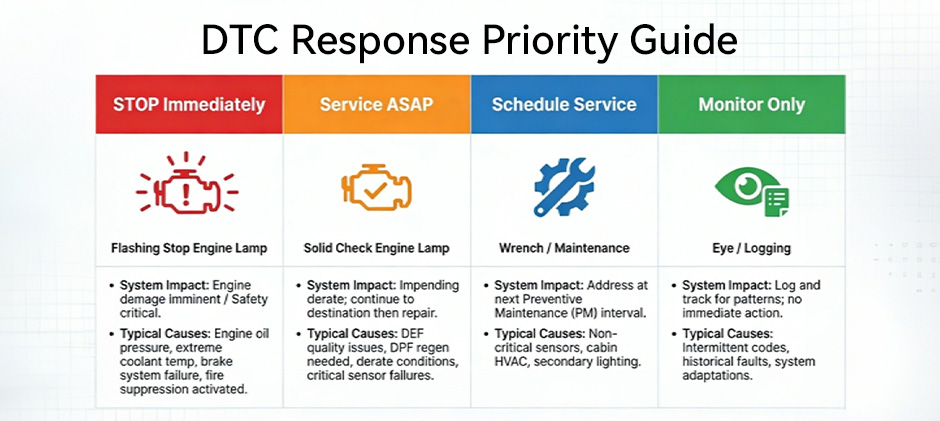
Use this technical guide for rapid triage decisions in the field. Categorizing faults allows for better allocation of maintenance resources.
- STOP Immediately: These faults indicate engine damage is imminent or a safety-critical failure has occurred. This includes low oil pressure, extreme coolant temperatures, or brake pressure loss.
- Service ASAP: You may continue to a safe parking area or a nearby shop before beginning repairs. Examples include DEF quality issues, DPF regeneration requirements, and primary sensor faults.
- Schedule Service: These issues should be addressed at the next preventive maintenance interval. They generally include non-critical sensors, cabin comfort faults, and secondary lighting.
- Monitor Only: These codes should be logged for pattern tracking. This category covers intermittent signal drops, historical faults, and routine maintenance reminders.
Conclusion
Managing the mechanical health of heavy equipment is a continuous process that requires attention to detail. We have seen how a proactive approach to identifying and resolving DTCs can prevent minor sensor issues from escalating into expensive engine failures. This guide provides the technical foundation needed to navigate the most common Freightliner faults efficiently. We believe that leveraging high-quality aftermarket parts is a smart strategy for fleet managers to keep maintenance costs manageable while ensuring the durability required for off-road operations. Stay committed to a rigorous diagnostic schedule to keep your machinery as productive as possible.
