

Grease is a semi-solid used to lubricate the machine parts. It plays a very important role in preventing mechanical friction, wear and corrosion. However, no two greases are exactly alike. Depending on their unique properties, different types have different effects. In this blog, we will learn about the types of grease and their uses. You make informed choices based on your needs.
What Is Grease?
Grease is a semi-solid lubricant. You can think of it as a “sponge holding oil.” It is mainly made up of three parts:
- Base oil (80–90%): This is the main lubricating component. It reduces friction between parts. It can be mineral oil or higher-performance synthetic oil.
- Thickener (5–15%): Like a “sponge,” it holds the base oil and keeps the grease thick so it doesn’t flow easily. Different types (such as lithium, calcium, or clay) also determine the grease’s performance.
- Additives (0–10%): These are used to improve performance, such as increasing extreme pressure (EP) resistance, preventing rust and corrosion, improving high-temperature performance, and reducing wear.
These three parts work together to help the grease stay in place and provide lasting protection where it’s needed most.
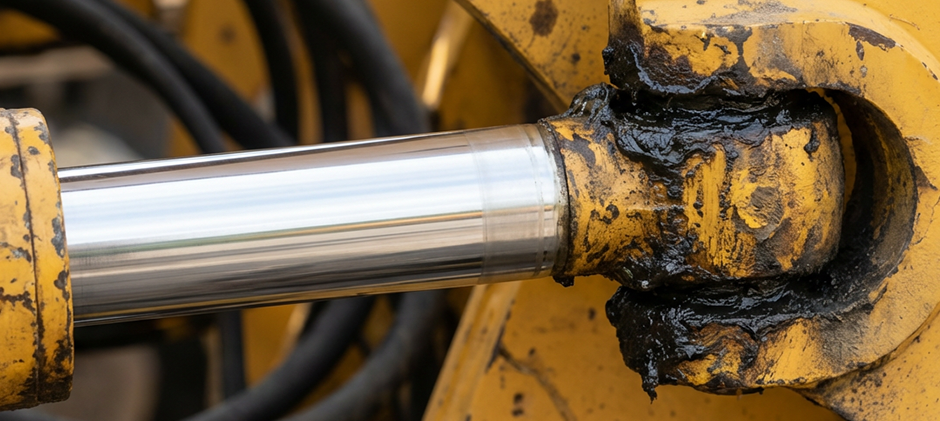
Grease Function
Why use grease instead of just spraying regular oil? Because grease has some unique advantages. It is especially good for the harsh working conditions of heavy equipment and is necessary.
- Strong adhesion: Regular oil can run off vertical surfaces and leak from unsealed gaps. Grease is thick and sticks to parts. It works well for moving parts in harsh environments, like bucket pins, main pins, and undercarriage lube points.
- Works as a seal: Grease can fill gaps in bearings and joints and form a protective layer. It keeps the lubricant inside. More importantly, it blocks dirt, water, and mud from getting in.
- Holds solid lubricants: For heavy-load areas, like boom pins on an excavator, grease can carry solid lubricants. Common ones are molybdenum disulfide (moly) and graphite. These particles stick to metal surfaces. When shock loads push out the oil film, they still provide protection. Regular oil cannot do this. The particles will settle at the bottom.
- Easier to use: Grease does not need a complex system or constant level checks. Just use a grease gun. Pump grease in until old grease comes out. This means the joint is fully lubricated and protected.
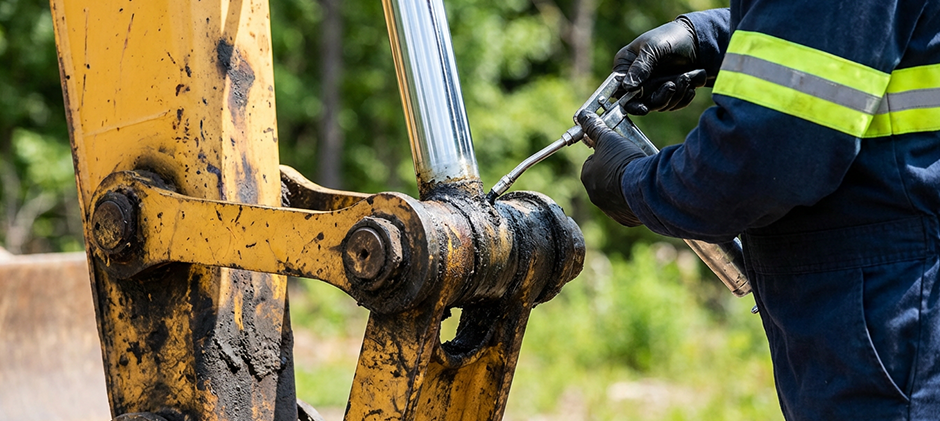
Types of Grease and Their Uses
A grease is named after its thickener. For off-road machines, only a few types can handle heavy loads, water, and changing temperatures. Let’s look at the ones you’ll most likely use.
Lithium and Lithium Complex Grease
This is the most common and widely used type of grease. You can think of it as the “go-to” option. Regular lithium grease is already a good all-purpose lubricant, but for heavy equipment, lithium complex grease is a better choice. The “complex” thickener gives it a higher dropping point (better heat resistance) and improved water resistance.
- Features: Good mechanical stability, strong high-temperature performance, and solid water resistance. With extreme pressure (EP) additives, it can handle heavy-load conditions.
- Uses: Like loaders, haul trucks, and other wheeled machines, it works well for general undercarriage lubrication, U-joints, and wheel bearings. NLGI #2 lithium complex EP grease is a great all-around choice, offering a good balance of performance and cost.
Calcium Sulfonate and Calcium Sulfonate Complex Grease
This is a high-performance grease that is becoming more common in heavy equipment. It’s popular for a reason. It has strong built-in properties, so it doesn’t need many extra additives to perform well.
- Features: Excellent water resistance. It naturally resists water, and it actually sticks better when exposed to moisture, making it ideal for wet and muddy conditions. It also has strong rust protection and natural extreme pressure (EP) performance.
- Uses: Great for critical parts that are exposed to water, such as bucket pins and bushings on excavators, backhoe loaders, and skid steer loaders. It’s also a good choice for equipment working in marine or very wet environments. Although it costs more, it offers better protection and helps extend component life.
Polyurea Grease
Polyurea grease is a high-performance, non-soap thickened grease known for its long service life and excellent stability.
- Features: It has strong oxidation resistance, so it doesn’t break down easily. It also has a high dropping point, good high-temperature performance, and decent water resistance. It is often used in sealed-for-life bearings.
- Uses: In heavy equipment, it is mainly used for electric motor bearings. It is commonly found in large electric mining trucks, electric conveyors, or any equipment with high-speed electric motors. It helps prevent bearing overheating, burning, or premature failure caused by using the wrong type of grease.
Bentone (Clay) Grease
Bentone grease is also called a “non-melting” grease. It uses clay as the thickener, so it does not have a traditional dropping point. At very high temperatures, it does not melt—it only becomes softer.
- Features: It has excellent high-temperature stability. Since it does not melt or drip, it stays in place even under heat, while other greases may soften and run off.
- Uses: It is suitable for parts that run at high temperatures but not necessarily under very high pressure. Common uses include brake adjusters, clutch release bearings, and kiln car wheel axles in manufacturing plants. It is a specialty grease designed for specific high-temperature applications.
Characteristics to Consider When Choosing Grease
Besides the thickener type, there are a few key properties you should check on the product data sheet to choose the right grease.
Consistency (NLGI grade)
Grease consistency is graded by the National Lubricating Grease Institute (NLGI). The scale runs from 000 (fluid, like cooking oil) to 6 (very hard, like block cheese).
For heavy equipment, around 90% of manual greasing uses NLGI #2 — the most common and versatile grade. It’s the perfect consistency: it stays on lubrication points well, but isn’t so thick that it’s hard to pump with a grease gun.
- NLGI #2: General-purpose, works for most bearings and chassis lubrication points.
- NLGI #1: Softer than #2, good for cold weather or centralized lubrication systems, as it pumps more easily.
- NLGI #0 / #00: Semi-fluid greases, used in automatic lubrication systems where smooth flow through long lines is needed.
Dropping Point
This is the temperature at which grease gets thin enough to start dripping when heated. It shows how well the thickener resists heat, but it’s not the actual maximum operating temperature. A good rule of thumb is that the maximum working temperature of grease is about 38°C (100°F) lower than its dropping point.
Water Resistance
This is extremely important for off‑highway equipment. It measures how well grease resists being washed away by water and mixing with water. Calcium sulfonate grease performs very well in this area.
EP (Extreme Pressure) & AW (Anti‑Wear) Performance
Look for the “EP” mark on the product — it means the grease has extreme pressure additives. These prevent metal‑to‑metal contact when the machine is under heavy shock loads, such as when an excavator bucket hits rock.
Grease with molybdenum disulfide (moly) or graphite adds an extra protective layer against wear. It’s ideal for slow‑moving, heavily loaded pins and joints.
Final Words
Matching the right grease to the working conditions is the key to getting the best protection for your equipment. By understanding the basics, you can choose the right type of grease with confidence.
When parts eventually wear out and need replacement, FridayParts offers aftermarket parts that fit many major brands. They are good quality and come at more competitive prices.
