

Buying a riding mower can be daunting when you’re used to operating a walk-behind mower. It’s much bigger and pricier. The myriad controls might confuse you too much. In this guide, we’ll talk about the Cub Cadet vs John Deere face-off and key factors to consider in terms of mower purchase.
About Cub Cadet vs John Deere
Cub Cadet was born in 1960 as a premium line of small tractors under International Harvester (IH), originally designed for homeowners with large lawns and private gardens. The brand offered a wide range of attachments, including mowers, blades, and snow blowers. In 1981, IH sold the brand to MTD Corporation, which continued producing Cub Cadet lawn tractors in the iconic white and yellow color scheme for lawn equipment dealers. In 2021, Stanley Black & Decker fully acquired MTD, and Cub Cadet remains one of the leading lawn tractor brands today.
John Deere, founded in 1837, entered the lawn and garden market in 1963 with the iconic Model 110, establishing its signature green and yellow color scheme. The brand offers a wide range of models from entry-level riding mowers (100 Series) to professional zero-turn mowers (X & Z Series), and keeps its recognition as one of the most reliable lawn tractor brands, backed by a strong dealer network and readily available parts.
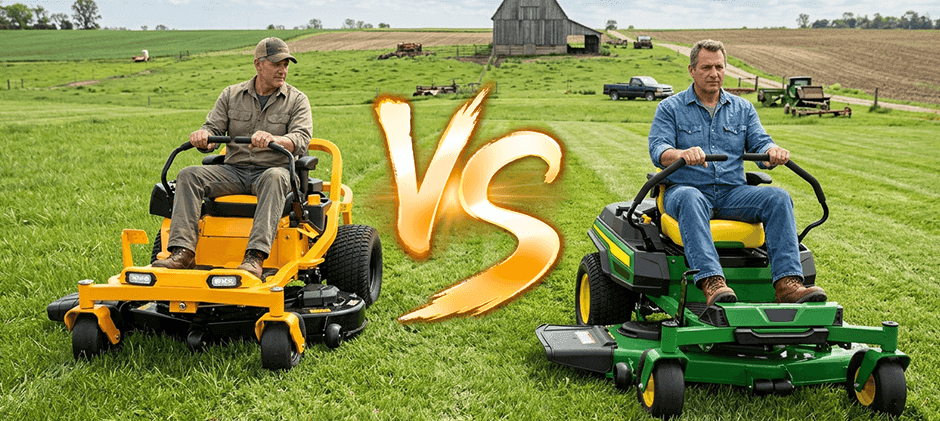
Cub Cadet vs John Deere: Lawn Tractor Face-Off
For the Cub Cader vs John Deere face-off, Consumer Reports has conducted a test between Cub Cadet XT1 LT42 and John Deere D130, two entry-level riding mowers that suit for beginners. You can find both at home centers. Which model gets the edge? Let’s see the face-off results by Consumer Reports.
Price (Updated)
The two riding mowers for beginners are all priced reasonably. The John Deere D130 riding mowers generally sell for between $850 and $1,500, depending on condition and hours, and are retailed for roughly $1,900 to $2,000. The Cub Cadet XT1 LT42 riding lawn mower is generally priced between $2,299 and $2,399 at major retailers like Home Depot. (The winner: John Deere D130)
Cutting
The John Deere D130 and Cub Cadet both registered excellent cutting performance in side-discharge mode and aced the bagging test by Consumer Reports. The difference lies in the mulching test, with Cub Cadet getting a slight advantage by churning grass clippings into fine fragments that recede into the earth and nourish the soil. The Deere won’t disappoint you with its performance if equipped with the mulching kit priced at $30 to $60. (The winner: Cub Cadet XT1 LT42)
Controls, Comfort, and Handling
Comfort should be top-of-mind when buying a riding mower, especially if you need to spend 50 hours or more on your tractor during each mowing season. Both Cub Cadet XT1 LT42 and John Deere D130 have a comfy and plush high-back seat and offer other features like an automatic drive system as well as washout ports for cleaning under the cutting deck with a hose. The Deere has an edge over the Cub Cadet in braking, steering, turning and stability tests with a slightly more refined ride. Anyway, both are serious improvement if you’re trading up from a push mower. (The winner: John Deere D130)
Reliability
According to Consumer Reports, John Deere is hands down the most reliable brand. There are 22% of John Deere models are estimated to break by the fourth year of ownership, compared with 37% for Cub Cadet. (The winner: John Deere D130)
Final Results for Cub Cadet vs John Deere
The Cub Cadet XT1 LT42 and John Deere D130 are both terrific riding mowers and a good buy for the money. If you plan to do a lot of mulching, just go for the Cub Cadet or spend a little more money and get a slightly superior handling and better reliability with the Deere.
Key Considerations For Future Mower Purchase
There are many considerations for choosing a new mower. Here are the checklists for your reference. In no certain order. We believe this is by no means exhaustive, you may have more that you find important and that many of us might overlook, please contact us, and we’ll get it updated. Thanks in advance for any of your valuable insights.
Engine
- Type of engine, carbureted or EFI/DFI.
- How easy and convenient is it to change engine oil and hydraulic oil and filters?
- What are the hourly oil change intervals? 100, 500, 1000 ?
- Adequate horsepower for deck size.
Deck
- Stamped or Fabricated deck?
- How many bolt heads are exposed under the deck to try to scrape around?
- How hard is the deck to raise and lower with foot and leg pressure?
- Is the deck height adjustment fast and simple or of poor design?
- Type of baffling under deck, adjustable or stationary.
- Pulley covers on deck, ease of removal to clean the top of the deck.
- Width of discharge opening.
- Blade removal bolt, from the top or bottom of the deck?
- How many grease zerks and where are they located?
- Trim side of the deck visibility from the operator seat.
Hydralics
- Homeowner, Commercial, or Industrial pumps?
- Smoothness of hydraulics. Type of hydraulic pumps and wheel motors.
- Length of travel of control arms.
Suspension
- Type of seat and suspension. Seating position, is it to high or to low?
- Vertical suspension only or fore/aft included
- Type of suspension system if any on frame, four corner front and rear, flex forks, etc.
- Wheelbase of the mower, is it long or short?
Miscellaneous
- Number of cup holders, storage compartment.
- Operator display console, what’s included: fuel gauge, tachometer, etc.
- Fuel capacity.
- Available options for mower
- Service and Warranty
- Dealer service if needed or will you do your own maintenance if necessary?
- Length and type of Warranty, reputation of manufacturer, and parts availability.
Intended Use
- Type of terrain: flat, slopes, hills, etc.
- Type of grass, manicured lawns, field grass, overgrown grass and weeds.
These are a few things from our customers before their purchases. The final conclusion is that no mower can meet all the needs of the user. But many are a lot closer than others. Naturally, we get accustomed to the previous mower, thinking it’s the best. If we look realistically at the pros and cons, likes and dislikes of the machine, it can help us make wiser choices in future purchases.
Conclusion
On the Cub Cadet vs John Deere face-off, both Cub Cadet and John Deere are reliable brands for lawn mowers and tractors. You must choose the right mower according to your specific requirements and budget. If you are trading up from a walk-behind mower to a riding lawn mower, John Deere D130 and Cub Cadet XT1 LT42 would be a better choice as an entry-level mower. FridayParts does not provide lawn mowers & tractors, but we stock a vast selection of mower replacement parts for various brands like John Deere, Cub Cadet, Toro and more. With FridayParts, you can enjoy a worry-free mowing season.
You May Also Like
A Face-off Between Kubota and John Deere Compact Tractors
