

A weak timing belt tensioner can turn a reliable excavator, skid steer, loader, or forklift into a no-start—or worse, a jobsite shutdown that costs real money per hour. In this article, we’ll show the most useful signs of bad timing belt tensioner, explain why they happen on off-road machinery, and walk through practical next steps so you can decide when to inspect, when to stop running, and when to replace parts.
What Does a Timing Belt Tensioner Do?
A timing belt tensioner does one job: it keeps the timing belt at the correct tension so the belt teeth stay fully engaged with timing gears/pulleys as the engine runs. Timing belts are toothed belts (often made of rubber or polyurethane) that run over multiple gears/pulleys. With heat, age, and long run hours, the belt slowly changes length and behavior. If tension is not controlled, the belt can flutter, wear fast, or lose precise timing.
On off-road machinery engines, stable timing is critical because the crankshaft and camshaft(s) must remain synchronized. When timing drifts, you can see rough running, weak power, smoke issues, hard starts, or fault codes—often before a full failure.
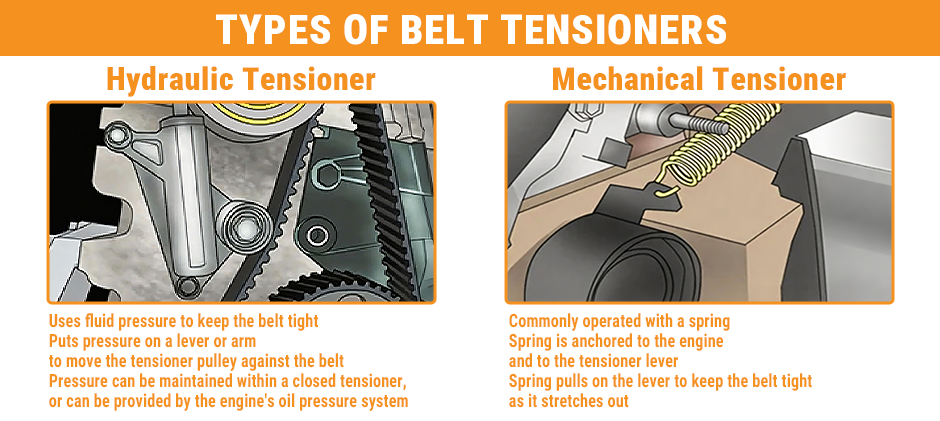
Two main types of timing belt tensioners
Many engines use one of these styles:
- Mechanical (spring-loaded) tensioner: uses spring force and a pivoting arm/pulley to keep tension as the belt ages.
- Hydraulic (oil-damped) tensioner: uses oil pressure in a sealed unit (like a small damper) to keep tension steady and reduce belt vibration.
Where to place your image: Put the “Types of Belt Tensioners” graphic right here as Fig. 1.
Suggested caption + alt text
- Fig. 1 — Types of timing belt tensioners
- Alt: “Diagram showing hydraulic and mechanical belt tensioners and how each applies force to the belt.”
Why Timing Belt Tensioner Failures?
Tensioners fail for reasons that match how off-road machinery lives: dust, vibration, long idle time, heat cycles, and heavy load changes. Most failures come from a short list of root causes.
1. Wear and tear
Every hour the engine runs, the tensioner pulley bearing spins. Over time, it can get rough, noisy, or loose. Mechanical springs can also lose force. Hydraulic units can lose damping if internal seals weaken.
2. Contamination
Off-road equipment operates in dirt, fines, and debris. If contaminants reach the tensioner pulley area, they can shorten bearing life. Oil or coolant leaks are also a big deal: fluids can damage belt material and reduce tooth grip, which increases belt slip risk and heat.
3. Misalignment and improper installation after service
A tensioner may be “new” but still fail early if the belt path is misaligned, bolts are not torqued correctly, or a worn idler pulley is left in place. Timing systems are linked—one weak part can take out the rest.
4. Overdue maintenance or unknown service history
This is common on used machines. If the last timing service is unclear, the tensioner may be near end-of-life even if the engine seems “fine.” Timing components often fail with little warning once they cross a wear threshold.
Transition point: Once the “why” is clear, the next step is spotting failure early. The signs below are written to help you make a quick call: inspect soon, stop now, or schedule replacement.
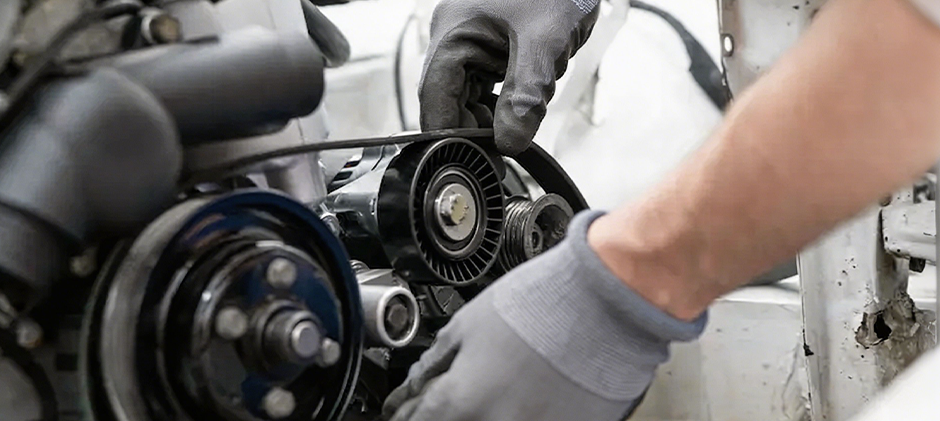
8 Signs of a Faulty Timing Belt Tensioner
1. Rattling or ticking from the timing cover area
A healthy timing system is usually quiet. When a tensioner can’t control the belt motion, the belt can flutter and create a light rattle/tick behind the timing cover. Hydraulic units may show a brief start-up rattle if damping is weak.
Why it matters: noise is often the first warning—before power loss shows up.
2. Squealing, chirping, or grinding that changes with RPM
A failing tensioner pulley bearing can squeal or chirp. If it gets worse, it may grind. The key clue is the RPM link: faster engine speed often makes the noise change.
Important: accessory drive systems can also squeal, so don’t assume. If the noise is from the accessory side, you may be dealing with a different belt system rather than timing.
3. Slapping or knocking sounds
When tension is too low, the belt can whip and contact parts inside the cover. That can sound like slapping/knocking. This is more urgent than a mild tick because it suggests the belt is moving too much.
4. Visible timing belt wear
If your machine design allows inspection access, look for:
- frayed edges (tracking/alignment issue)
- cracks (age/heat cycles)
- glazing/shiny belt surface (heat and slip)
- damaged or rounded teeth (poor mesh, debris, or tension problems)
Even if the belt is the only visible part, belt wear often points back to tensioner control or pulley alignment.
5. Hard starting, long cranking, or occasional no-start
If the timing belt tensioner can’t keep the belt tight, the crank and cam timing can drift enough to cause poor starting. On off-road machinery, this can show up as:
- longer crank time
- rough start, then smooth later
- starts fine warm, struggles cold (or the reverse)
Why it matters: Starting trouble tied to timing is not “just annoying.” It can be a pre-failure sign.
6. Rough idle, misfire-like running, or unstable engine feel
Valve timing that’s slightly off can cause rough running. You might notice:
- shaky idle
- uneven response at steady throttle
- misfire-like feel under load
This is especially noticeable in machines that do repeated load/unload cycles (bucket work, pushing, lifting, grading).
7. Loss of power or sluggish response under load changes
A tensioner that can’t control timing during fast throttle changes can cause brief timing drift. The belt teeth usually don’t “slip like a smooth belt,” but timing can still be off for moments—enough to feel like a weak pull or slow response when you need torque.
Field clue: if power loss comes with timing-area noise, don’t keep guessing—inspect.
8. Warning light or fault codes tied to timing correlation
Newer off-road engines may log codes when sensor signals (crank vs cam) don’t match expected timing. A loose belt system can trigger these events. Codes alone don’t prove a bad tensioner, but codes + noise + hard starting is a strong pattern.
Quick decision table
| Symptom | Risk level | Best next move |
|---|---|---|
| Light tick/rattle near timing cover | Medium | Inspect soon; plan service |
| Grinding/squeal from the timing area | High | Stop and inspect; bearing may be failing |
| Slapping/knocking inside cover | High | Don’t run; inspect immediately |
| Visible belt damage | High | Replace the belt and inspect the tensioner/idlers |
| Hard starting + rough idle | High | Diagnose the timing system before more hours |
| Power loss under load + noise | High | Treat it as a timing control issue; inspect |
| Timing-related codes + symptoms | High | Verify timing components and alignment |
| Unknown service history | Medium–High | Check OEM interval; schedule inspection/service |
How to Fix it?
Fixing a tensioner issue is mostly about finding the root cause and replacing parts as a set when needed. Timing systems reward careful work and punish shortcuts.
Step 1: Confirm whether the noise is timing-side or accessory-side
Many off-road machines have both:
- timing belt system (under a cover)
- accessory drive belts (alternator, water pump, fan drive, etc.)
If the issue is accessory-side, it may involve a different belt and tensioner arrangement. For accessory belt options and related parts, start here: belt
Step 2: Inspect the timing belt system
A useful inspection checklist:
- Belt condition (teeth, edges, cracks, glazing)
- Tensioner pulley bearing feel (roughness, wobble, noise)
- Idler pulleys (spin feel, noise)
- Signs of contamination (oil/coolant residue, dust build-up)
- Cover condition and sealing (to keep debris out)
- Alignment marks (only if you have the correct procedure and tools)
If the belt shows wear, plan to replace it—not “tighten and hope.”
For the timing belt itself (correct fit matters), use this category: timing belt
Step 3: Replace the tensioner when the symptoms match belt control loss
If multiple signs of bad timing belt tensioner are present—especially grinding noise, slapping, belt damage, or timing codes—replacement is usually the safe call. Many techs replace the tensioner along with the belt during normal timing service because labor overlap is large, and a weak old tensioner can ruin a new belt.
To shop heavy-equipment compatible options, use: belt tensioner
Step 4: Follow safe replacement practices
Timing service can be complex and engine-specific. If you’re not trained or don’t have locking/alignment tools, it’s safer to hand this job to a qualified tech. For those who do have the right tools and manual, a typical workflow looks like this:
- Shut down, cool the engine, and lock out power safely
- Remove covers as required
- Set the engine at the specified timing position and lock it if required
- Release tension, remove belt, inspect pulleys/idlers
- Replace worn components (often belt + tensioner + idlers)
- Refit the belt, confirm tooth engagement and alignment
- Set tension per procedure (not “extra tight”)
- Rotate the engine by hand (per manual) and re-check alignment
- Reassemble, run, and listen for abnormal noise
Avoid two common mistakes:
- Over-tensioning: can overload bearings and shorten life
- Mixing mismatched parts/specs can cause tracking issues and fast wear
FAQs
1) Can a bad timing belt tensioner damage the engine on off-road machinery?
Yes. Loss of timing control can lead to poor running and, on some engine designs, serious internal damage if timing jumps far enough. It can also cause belt failure and downtime.
2) What’s the most common early warning sign?
Abnormal noise near the timing cover—rattling, ticking, chirping, or grinding—is one of the earliest and most common signs, often before power loss becomes obvious.
3) Should the timing belt and tensioner be replaced together?
Often, yes—especially near the OEM service interval or if the belt shows any wear. Replacing them together reduces repeat labor and lowers the chance that an old tensioner harms a new belt.
4) How long do timing belt tensioners last on heavy equipment?
There isn’t one universal number because it depends on engine design, duty cycle, dust exposure, and maintenance. The best guide is your engine’s service manual and inspection results.
5) If there’s a squeal, is it always the timing belt tensioner?
No. Accessory belts and their pulleys/tensioners can squeal, too. Location and symptoms matter: timing-related hard starting, rough idle, belt wear under the timing cover, and timing codes point more toward timing components.
Conclusion
A failing timing belt tensioner is not just a noise issue—it’s timing control slipping away. Catching the signs of bad timing belt tensioner early can prevent lost work hours and reduce the risk of bigger engine damage. If symptoms stack up (noise + belt wear + hard starting), inspect soon and replace parts as a set when needed.
